Division Dash
Division shares a total equally: the quotient tells how many belong in each group (or how many equal groups can be made), and any amount left over is the remainder.
What your child will figure out
- Share a visible total equally into a stated number of groups and identify the quotient.
- Switch between sharing and grouping interpretations of division.
- Interpret a remainder as items that cannot complete another equal group.
- Use multiplication and arrays to check a quotient in campaign and adaptive practice.
The levels
- First lunch rush
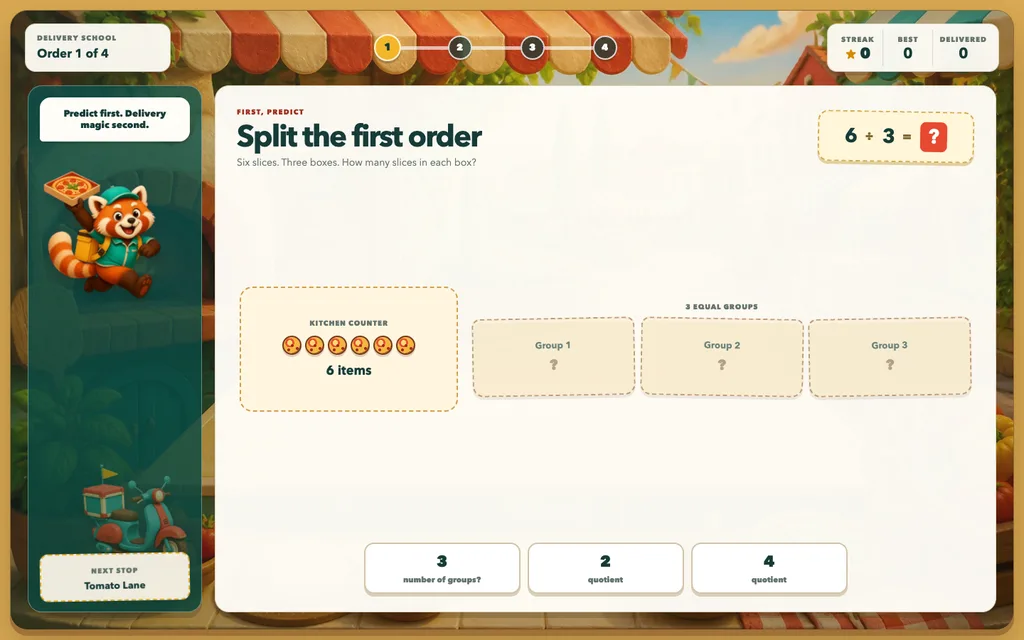
Predict 6 ÷ 3, deal six slices equally into three delivery boxes, observe two in each, and explain equal sharing.
- Pack by order
Treat division as grouping by finding how many groups of three can be made from twelve items.
- The extra bites
Share fourteen bites across four boxes and keep the two leftovers visible as the remainder.
- Market array transfer
Transfer division to a 4-row market display and use 4 × 5 = 20 to check the missing factor.
- Six-box supper
Scale equal sharing to 24 ÷ 6 and preserve the one-item-per-group round structure.
- Snack stacks
Pack thirty items into complete groups of five and use 6 × 5 = 30 as the check.
- Three on the counter
Interpret 23 ÷ 5 as four equal shares with three visible leftovers.
- Festival tray array
Transfer division to a 6-row array and recover the missing factor in 6 × 7 = 42.
- Look-alike numbers
Distinguish divisor from quotient even when both happen to be six in 36 ÷ 6.
- Express orders
Use fluent grouping to solve 56 ÷ 7 and check eight complete groups multiplicatively.
- Almost-full round
Solve 67 ÷ 8, preserve remainder three, and reject rounding the quotient up.
- Grand market transfer
Transfer all four ideas to an 8-row display and prove 72 ÷ 8 = 9 with multiplication.
Ready when they are.
Play Division Dash free — no account, no card.
Play Division Dash free