The best algebra games in 2026
Every algebra teacher knows the moment it goes wrong: x stops meaning anything and starts being a letter you move around. The best algebra games keep equations physical — balances, boxes, weights — until the moves are obvious before they're symbolic.
Early algebra is hard because the equals sign and the variable are often misunderstood before solving even begins. Many children read equals as “write the answer next” and x as a label rather than an unknown quantity. Then “move it to the other side” becomes a fragile rule. Algebra starts to click in late elementary and middle school when an equation is understood as two equal amounts and every legal step preserves that relationship, whether the unknown is a box, a weight, or a letter.
A good algebra game makes equality behave visibly. Look for a balance or another model where changing one side alone has an immediate consequence, and where children choose an operation before seeing the result. Problems should include unknowns in different positions, not only x plus a number. A bad game disguises worksheets with coins or enemies and praises answer speed. Strong play makes the child undo operations, test a value, and explain why the same action must apply to both sides.
Ten to fifteen minutes is enough for a small set of equations done thoughtfully. Ask, “What is being done to the unknown?” followed by, “How can we undo it without breaking the equality?” At the kitchen table, set equal piles of coins on two plates. Hide the same number under two cups, add visible coins, and write the matching equation. Let your child remove equal amounts from both plates until the hidden quantity can be worked out and checked.
Top picks for 2026
1. Balance Lab
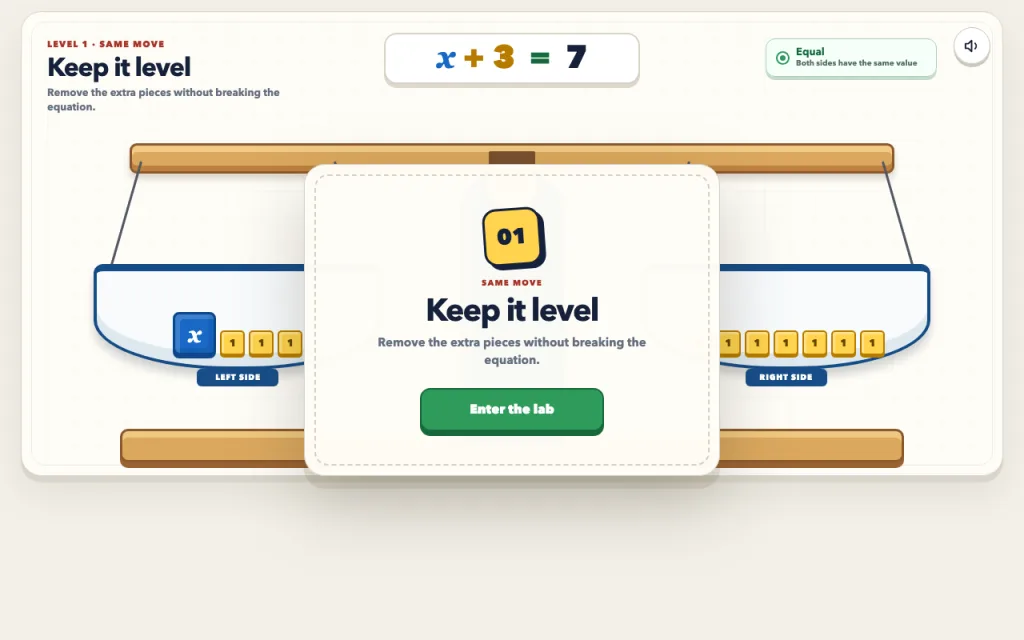
Algebra Balance Lab puts every equation on a real scale: remove three from both sides and it stays level; cheat one side and it tips. Your child frees the x tiles, spots the trap, then runs the lab solo. Vault Cracker follows up with two-step equations as safe-cracking. Ako, the voice AI tutor, coaches the reasoning, never the answer. Ages 11–13, first lesson free.
Common questions
What age should kids start algebra?
Informal algebra — balance puzzles, missing-number problems — works from age 9–10. Formal symbolic algebra typically starts in grades 6–8, and lands much softer if the balance model came first.
Do algebra games actually work?
Games that model equality physically (balances, DragonBox's boxes) have real evidence behind them. Games that just wrap drill in points mostly speed up what a child already knows.
Is Algebra Balance Lab free?
First lesson free in the browser, no account. A subscription unlocks Vault Cracker and the rest of the 100+ catalog.