The best human body games for kids in 2026
Anatomy is naturally fascinating to kids — it's their own machine. The best human body games go past labeling diagrams and let kids see the systems working: hearts pumping, lungs trading gases, layers fitting together.
Human-body learning becomes difficult when organs are taught as separate labels. Children may say the lungs “make” air, place the stomach across the whole abdomen, or treat blood as something the heart uses up. The important step is systems thinking: structures have jobs, materials move, and body systems depend on one another. Basic organs interest even young children, but the model deepens in upper elementary and middle school when kids can trace oxygen, food, or waste through more than one connected system.
A good body game makes organs do their work. Look for moving blood, changing pressure, gas exchange, digestion, or layers that fit in realistic positions, with a chance to predict what a blockage or damaged part would affect. Labeling diagrams is useful vocabulary practice, but it cannot show interdependence. Weak games turn anatomy into a scavenger hunt. Strong ones let a child follow a material through the body, alter one structure, and explain the downstream consequence without relying on gore or spectacle.
Play for fifteen minutes and follow one system at a time. Ask, “What enters this organ, what leaves, and what changed?” or “Which other system helps it do that job?” At the kitchen table, trace a cracker and a sip of water through a simple body outline drawn on paper. Then add the oxygen needed to release energy from the food, using a different color to show its route from the lungs through the blood to the muscles.
Top picks for 2026
1. Body Explorer
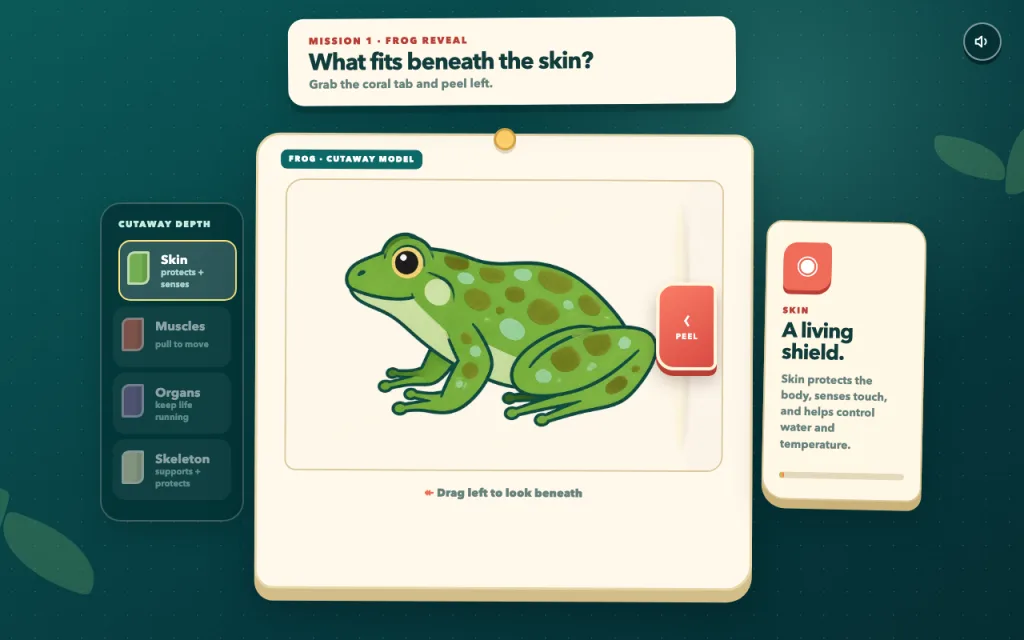
Body Explorer lets your child peel a frog — then a dog — layer by layer from skin to skeleton, find the organs at work, and match each body part to its job. Heart Pump Lab goes deeper on the heart: valves, pressure, and why exercise speeds the beat. Ako, the voice AI tutor, guides without spoiling. Ages 9–13, first lesson free.
Common questions
What age do kids learn body systems?
Basic organs and senses in grades K-2, body systems (circulatory, respiratory, digestive) in grades 4–6, and cellular detail in middle school.
What makes a body game good?
Function over labels. Naming the heart is trivia; watching a stuck valve make blood flow backwards is understanding. Look for games where the body *does* something.
Is Body Explorer free?
First lesson free in the browser, no account. A subscription unlocks Heart Pump Lab, Cell Factory and the full catalog.