The best money games for kids in 2026
Money is math with stakes kids actually feel — which makes it the easiest place to smuggle in arithmetic practice. The best money games run real shops with real change, not just coin-identification flashcards.
Money combines coin recognition, place value, decimal notation, and subtraction inside one task. Children may believe a larger coin is worth more, count coins instead of their values, or subtract a purchase from the cash in the wrong order. Cash also makes equivalence concrete: five nickels and one quarter are different collections with the same value. These ideas usually click between ages 7 and 10 when children buy, combine, and make change instead of naming coins in isolation.
A good money game runs a believable transaction. Look for several ways to make an amount, limited coins and bills, change that must be counted back, and prices that require estimation before exact calculation. Coin-matching games are fine for beginners but should lead somewhere. Weak shop games choose the payment automatically or celebrate random purchases. Strong ones make the child decide how to pay, notice an overpayment, check the change, and distinguish revenue from profit when older learners are ready.
Use a fifteen-minute shop session and take turns being customer and cashier. Ask, “Is that enough before we count exactly?” and “How can you check the change another way?” At the kitchen table, price three snack items with sticky notes and give your child a fixed set of real or paper coins. Buy two items, count up from the total to the amount paid, and compare that method with subtraction. Let the cashier correct any mistake before switching roles.
Top picks for 2026
1. Money Market
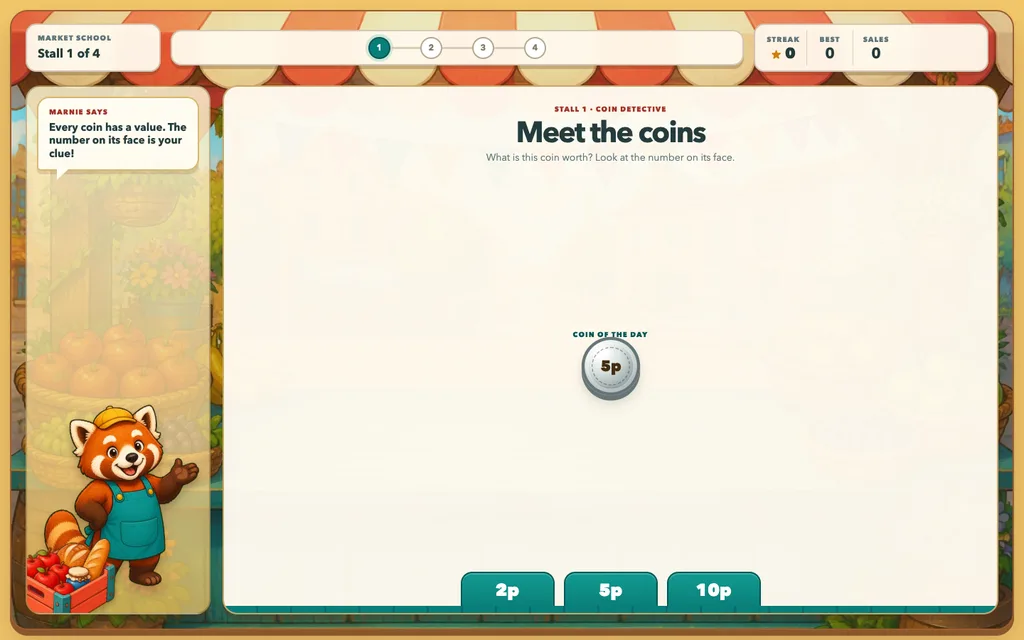
Money Market puts your child behind a market stall: price the goods, take payments, count exact change back, and feel the difference between profit and just being busy. Coins clink, sales cha-ching, mistakes cost. Ako, the voice AI tutor, plays the friendly regular customer. Ages 7–11, first lesson free.
Common questions
What age should kids learn money math?
Coin names and values around 5–7, making amounts and counting change 7–9, and budgeting ideas (earning, saving, profit) from 9 up.
Do money games still matter in a cashless world?
More than ever — when money is invisible, the arithmetic intuition has to come from somewhere. Making change is also the best mental-subtraction practice in elementary school.
Is Money Market free?
First lesson free in the browser, no account. A subscription unlocks the full catalog.