The best multiplication games in 2026
There are two kinds of multiplication games: ones that drill facts kids already understand, and ones that build the understanding. Most lists only have the first kind. Both matter — here's the honest split.
Multiplication is more than fast recall. Children need to connect equal groups, arrays, repeated addition, scaling, and the relationship with division. A child may recite 6 × 7 while being unable to represent it, or confuse six groups of seven with six plus seven. The concept begins to click around grades 2 through 4 when arrays make commutativity visible and known facts can generate unknown ones. Fluency then becomes retrieval backed by structure, not a stack of unrelated answers.
A good multiplication game first lets children build or split groups, then uses that understanding to support fact practice. Look for arrays that can be rearranged, missing-factor problems, and prompts to predict a product before counting. Timed drills are appropriate once strategies are secure, but points and speed do not teach what multiplication means. Weak games punish slow recall; strong ones show how 7 × 6 can be derived from 5 × 6 plus 2 × 6 and invite children to use that relationship.
Spend ten to fifteen minutes, with more time explaining strategies than chasing a score. Ask, “How could you break that fact into two facts you know?” and “What does each number describe in your picture?” At the kitchen table, arrange 24 small items in rectangular arrays. Find every possible row-and-column layout, write the matching facts, and turn the arrays sideways to show why changing the order of the factors does not change the total.
Top picks for 2026
1. Block Builder
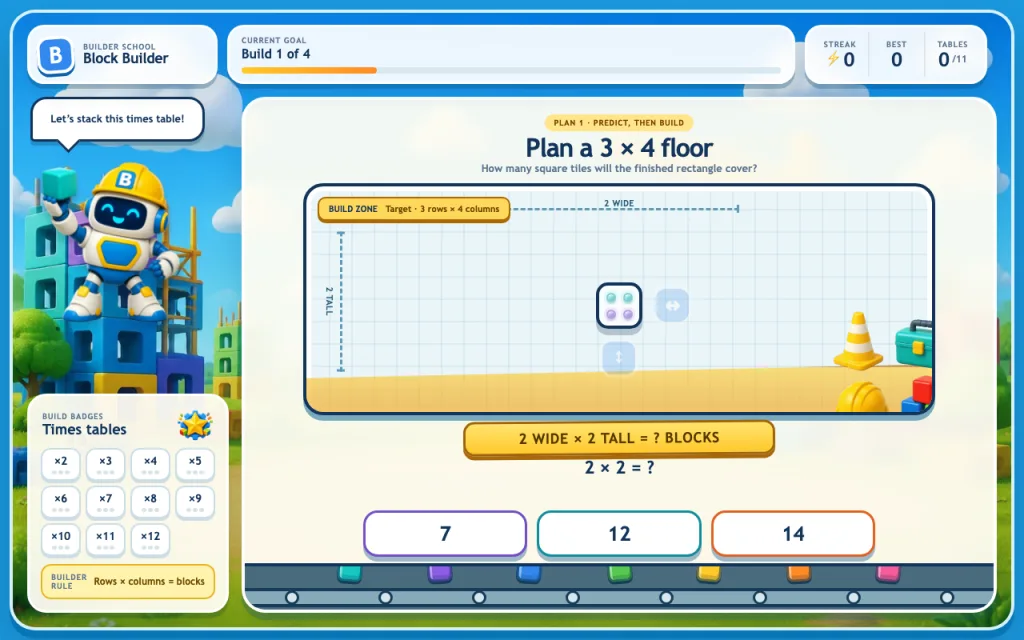
Block Builder teaches what multiplication *is*: your child builds rectangles — three rows of four, six columns of seven — and discovers that rows × columns counts every block. Missing-factor walls (6 × ? = 42) turn division into the same picture. Ako, the voice AI tutor, keeps asking why. Ages 7–12, first lesson free.
Common questions
What order should kids learn times tables?
2s, 5s and 10s first (skip-counting patterns), then 3s and 4s, then squares, leaving 6×7, 7×8 style facts last. Arrays make the commutative shortcut obvious — 7×8 is 8×7, so there's half as much to learn.
Drill or understanding first?
Understanding first, always — a child who can rebuild 6×7 from 6×5 + 6×2 never really forgets it. Then drill for speed once it means something.
Is Block Builder free?
First lesson free in the browser, no account. A subscription unlocks the full catalog including Skip Count Safari and Division Dash.