The best plate tectonics games in 2026
Plate tectonics is the rare topic that explains half of earth science at once — mountains, earthquakes, volcanoes, ocean trenches — if a kid can just see the plates move. Simulations beat diagrams here, badly.
Plate tectonics is difficult because the movement is too slow and too large to observe directly. Children may imagine continents floating freely on liquid magma, assume every volcano sits at a boundary, or treat earthquakes and mountains as unrelated facts. The unifying model usually clicks in middle school when students connect plate motion with several kinds of evidence and see that convergent, divergent, and transform boundaries produce different, predictable patterns on Earth’s surface.
A strong plate tectonics game lets children control relative plate motion and watch landforms or hazards develop. Look for differences between oceanic and continental crust, predictions before collision or separation, and maps that connect the model to real boundary patterns. A labeling quiz can teach the three boundary names while leaving their mechanisms vague. Better games make direction, density, and time matter, so a child can explain why one collision builds mountains while another sends a plate beneath its neighbor.
Play for fifteen or twenty minutes, comparing two boundary types rather than rushing through all of them. Ask, “Which way is each plate moving?” and “What surface evidence would this leave behind?” At the kitchen table, press two folded towels together to model crumpling, pull them apart over a strip of colored paper to expose new material, and slide them past each other until friction releases. Match each motion to a real location on a map.
Top picks for 2026
1. Tectonics
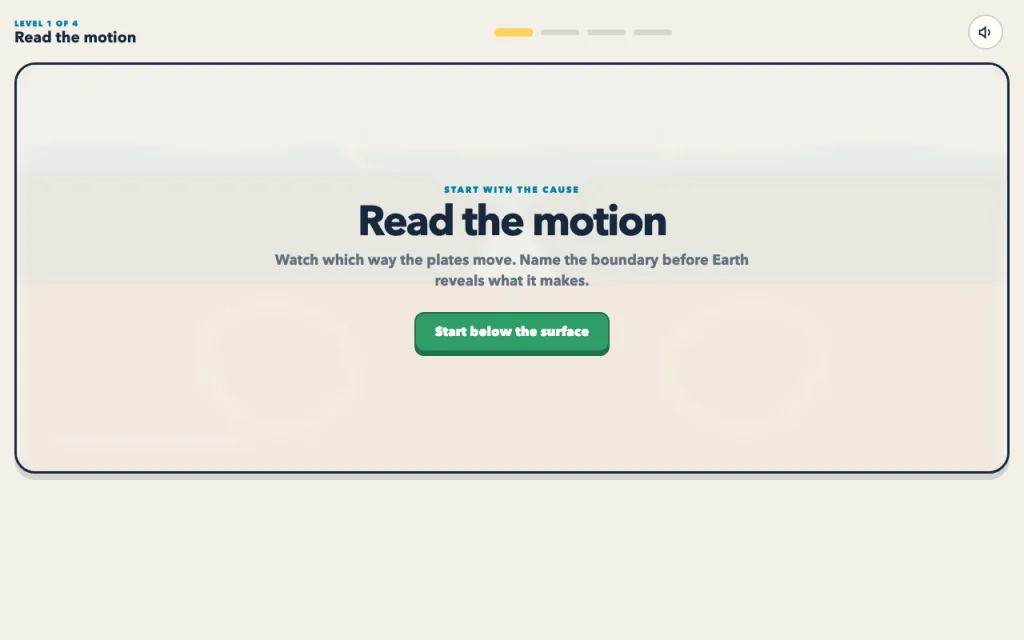
Plate Tectonics Puzzle lets your child drive the plates: push them together and watch mountains crumple up, pull them apart to open rifts, slide them past each other and feel the earthquake snag. Each boundary type becomes something they caused. Ako, the voice AI tutor, connects it to real places. Ages 10–13, first lesson free.
Common questions
What grade covers plate tectonics?
Introduced in grades 4–5 (volcanoes, earthquakes), taught properly with boundary types and evidence in grades 6–8.
What's the key idea kids should take away?
That the map is temporary: continents drift about as fast as fingernails grow, and every mountain range and trench is a boundary story. Once that clicks, earth science becomes detective work.
Is Plate Tectonics Puzzle free?
First lesson free in the browser, no account. A subscription unlocks Volcano Inside, Fossil Dig and the full catalog.