The best probability games in 2026
Probability is the most intuition-hostile topic in school math — even adults feel the gambler's fallacy. The best probability games let kids run hundreds of trials fast enough to watch the long run emerge and beat their gut.
Probability is hard because everyday intuition is built from small samples and memorable streaks. Children may believe five heads make tails “due,” confuse unlikely with impossible, or expect ten coin flips to contain exactly five of each result. Informal chance language starts young, but the subject clicks more fully in grades 6 through 8 when students separate one unpredictable event from a stable long-run pattern and connect theoretical fractions with results gathered over many trials.
A strong probability game lets children state a prediction, run repeated trials quickly, and compare expected with observed results. Look for editable spinners, dice, or bags so the sample space is visible, plus graphs that update without hiding early variation. Games based only on choosing the “most likely” picture stay shallow. Bad mechanics imply that a streak changes an independent event. Good ones let a child test that belief across hundreds of trials and explain why short runs can look uneven without making the process unfair.
Use fifteen-minute sessions, beginning with a small batch of trials and then increasing it. Ask, “What do you expect in the long run?” and “Did the last result change the next event’s chances?” At the kitchen table, put three red and one blue piece of pasta in a bag. Predict ten draws with replacement, record them, then run forty more. Compare the proportions and discuss why the results moved closer to, but did not have to equal, three quarters red.
Top picks for 2026
1. Probability Machine
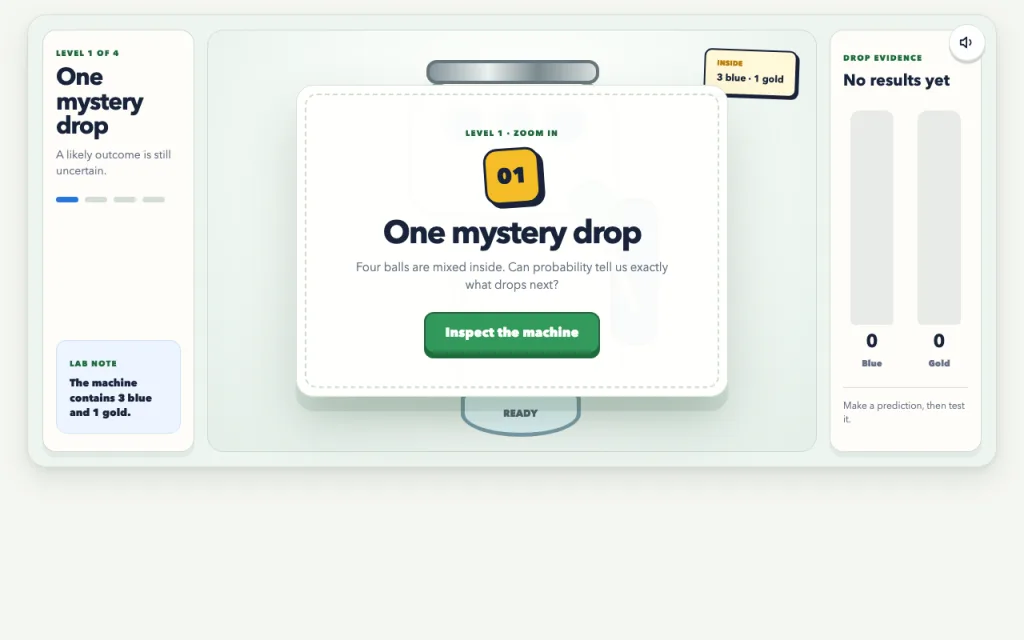
Probability Machine hands your child a spinner-and-marble contraption they can rig themselves: predict, run one trial, then run five hundred and watch the proportions settle. The 'due for a win' feeling gets tested — and loses — in front of them. Ako, the voice AI tutor, asks for the prediction every time. Ages 10–13, first lesson free.
Common questions
What age do kids learn probability?
Likely/unlikely language starts around grade 3; fractions-as-probability and experimental vs theoretical probability land in grades 6–8.
Why do kids (and adults) get probability wrong?
Because intuition tracks short runs and stories, not long-run frequencies. The fix is watching many trials accumulate — which is exactly what a simulation game does in seconds.
Is Probability Machine free?
First lesson free in the browser, no account. A subscription unlocks the full catalog.