The best telling time games in 2026
Analog clocks are two number lines wrapped into one circle — no wonder six-year-olds find them weird. The best telling time games let kids drive the hands themselves so the hour hand's slow creep finally makes sense.
An analog clock asks children to coordinate two scales on one face. The 3 can mean three hours for one hand and fifteen minutes for the other, while the hour hand moves between numbers instead of jumping once an hour. Children often read 7:45 as 8:45 because the short hand is near eight. The model usually clicks between ages 6 and 8 when kids move linked hands and see that one full minute-hand turn produces one hour-hand step.
A useful telling-time game lets the child set and run a clock, with both hands moving together. Look for times between the hour marks, matching analog and digital displays, and elapsed-time challenges where the clock visibly advances. Games that freeze the hour hand directly on a numeral teach a misleading picture. Pure multiple-choice drills may improve recognition, but good mechanics reveal why half past eight places the short hand halfway toward nine and why crossing twelve changes the hour.
Keep practice to ten minutes and mix reading a clock with building a requested time. Ask, “Which hour have we passed?” and “How many minutes have gone since then?” rather than asking where each hand points. At the kitchen table, use a paper plate, a split pin, and two cardboard hands to make a clock. Choose a real event, such as dinner at 6:30, set the start time, and move both hands together to find how long remains.
Top picks for 2026
1. Clock Workshop
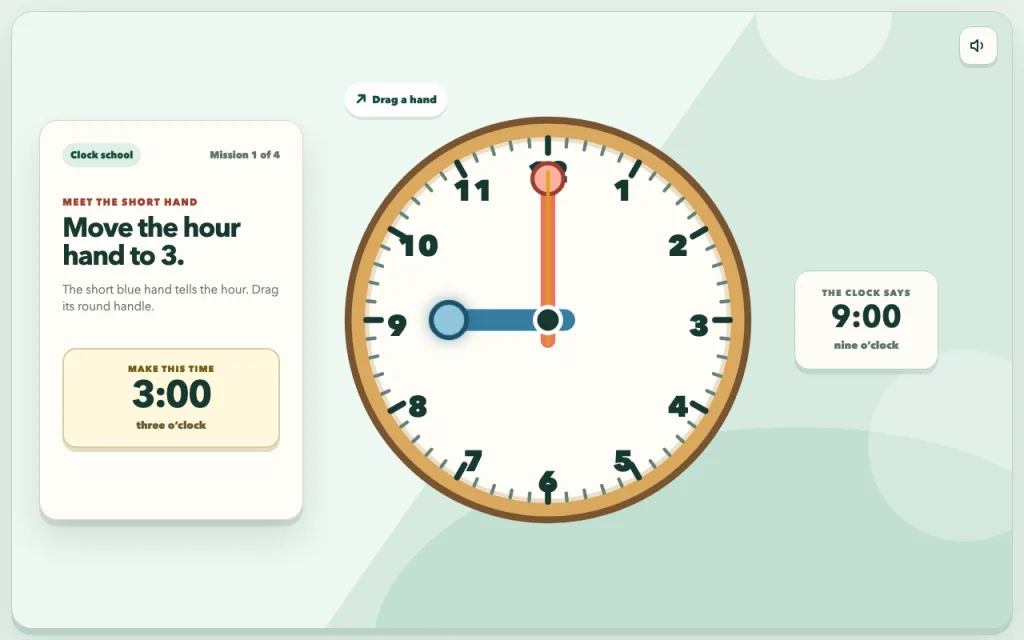
Clock Workshop hands your child the hands: set three o'clock, discover why the minute hand's lap moves the hour hand halfway, build half past eight from scratch. Elapsed Time Station picks up from there for older kids. Ako, the voice AI tutor, narrates what each hand is doing and why. Ages 6–11, first lesson free.
Common questions
What age should a child tell time?
O'clock and half past around ages 6–7, five-minute precision by 8, and elapsed-time problems ('how long until soccer?') from 9 up.
Why are analog clocks still worth teaching?
Beyond reading the kitchen clock: the clock face is a circular number line, and practicing it quietly builds fractions (quarter past), skip counting (by 5s), and angle sense all at once.
Is Clock Workshop free?
First lesson free in the browser, no account. A subscription unlocks Elapsed Time Station and the rest of the catalog.