Money Market
Money amounts are totals of coin and note values; exact payment matches a price, while change is the difference between what was paid and what it cost.
What your child will figure out
- Read printed coin and note values, then count mixed sets by grouping and adding every value once.
- Build exact payments in multiple efficient ways and explain why different combinations can be equivalent.
- Move fluently between pence and pounds-and-pence amounts, including totals above £1.
- Find change and money remaining as the difference between a price or spend and the amount available.
The levels
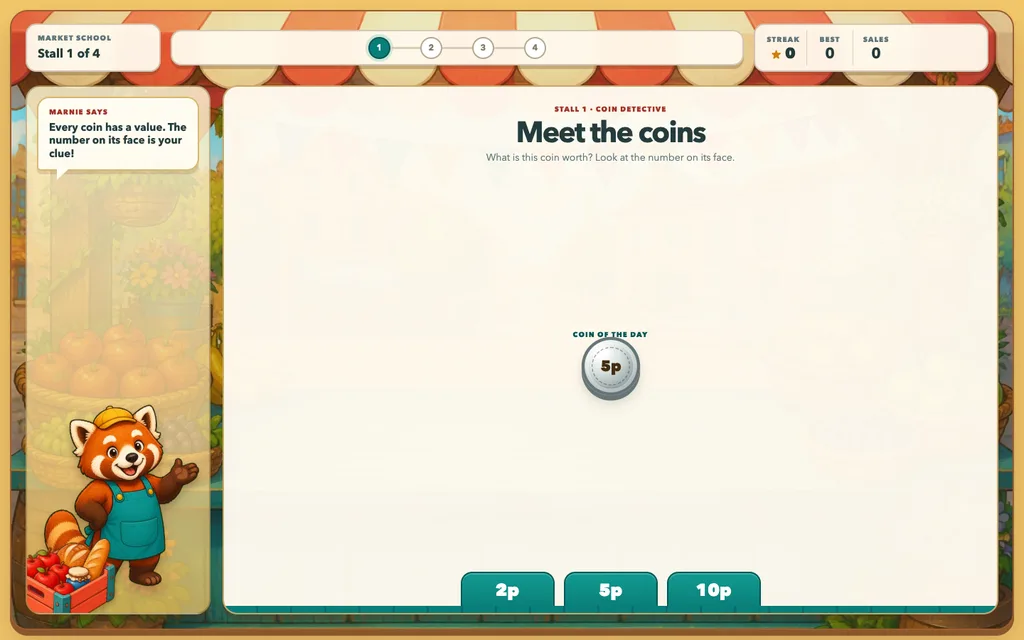
- Meet the coins
Predict a coin's value, inspect its face, and explain that the printed number tells its value.
- Spot the silver coin
Use the printed 50p label instead of colour or size to identify a less familiar coin.
- Count the basket
Count every value in a four-coin set, observe the till total, and explain the sum.
- Count a busy till
Group and total five mixed denominations efficiently without using coin count or the largest coin as the answer.
- Pay for the picnic
Build and check an exact 17p payment by combining coin values.
- Another way to pay
Compose 30p without a 20p coin to show that different coin combinations can be equivalent.
- Pounds and pence
Treat £1.35 as 100p plus 35p and build the amount exactly.
- Choose efficient coins
Use larger denominations to compose £2.75 efficiently while checking total value.
- The change challenge
Transfer value-adding to make 7p change from 20p paid for a 13p item.
- Change from a pound
Bridge through a round 100p boundary to find 32p change from £1.
- Plan a £5 budget
Apply difference to find and build £1.53 remaining after spending £3.47 from £5.
- Run the festival stall
Transfer all prior strategies to make £3.62 change from £10 for a £6.38 order.
Ready when they are.
Play Money Market free — no account, no card.
Play Money Market free