Roman Quest
Roman numerals use symbols with fixed values; reading from left to right usually adds them, but a smaller value before a larger value is subtracted.
What your child will figure out
- Recall the values of I, V, X, L, C, D, and M.
- Convert additive Roman numerals to Arabic values by combining every symbol value.
- Use the subtractive rule in forms such as IV and IX instead of adding every symbol.
- Build canonical Roman numerals across ones, tens, hundreds, and thousands, then continue with varied adaptive conversions.
The levels
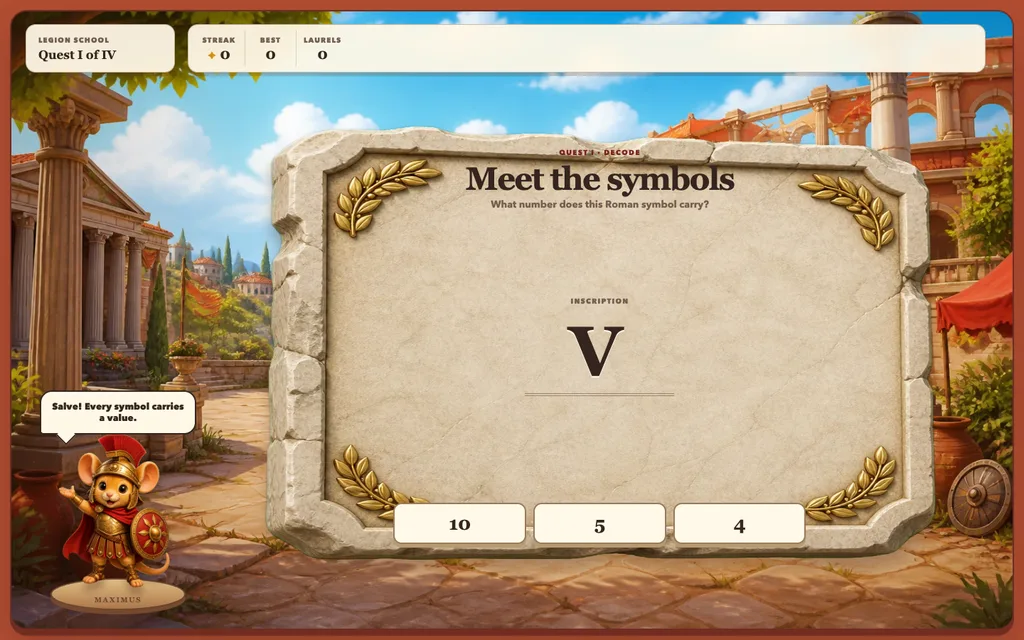
- Meet the symbols
Predict V's value, observe its fixed value, and explain that a Roman symbol always carries the same amount.
- March and add
Read VIII as 5 + 1 + 1 + 1 and explain why additive order makes eight.
- The sneaky I
Contrast IX with 11, observe the smaller-before-larger relationship, and explain the subtractive rule.
- Raise the gate
Transfer both rules by building the canonical Roman numeral XIV for a new Arabic target.
- The long march
Extend additive reading across repeated tens, a five, and ones in XXVII.
- Before the fifty
Scale the subtractive rule from ones to tens by interpreting XL as 50 − 10.
- Two hidden fours
Build a canonical numeral containing subtraction in both the tens and ones places.
- Double subtraction
Chunk XCIX into two subtractive pairs and combine 90 with 9.
- The centurion's tally
Read a longer descending additive numeral using C, L, X, V, and I.
- The triple gate
Build 444 canonically with subtraction in the hundreds, tens, and ones places.
- At the edge of a thousand
Coordinate hundreds, tens, and ones subtraction by decoding CMXCIX.
- Seal the imperial archive
Transfer the full system by building a four-digit canonical numeral with thousands, tens, and subtraction.
Ready when they are.
Play Roman Quest free — no account, no card.
Play Roman Quest free