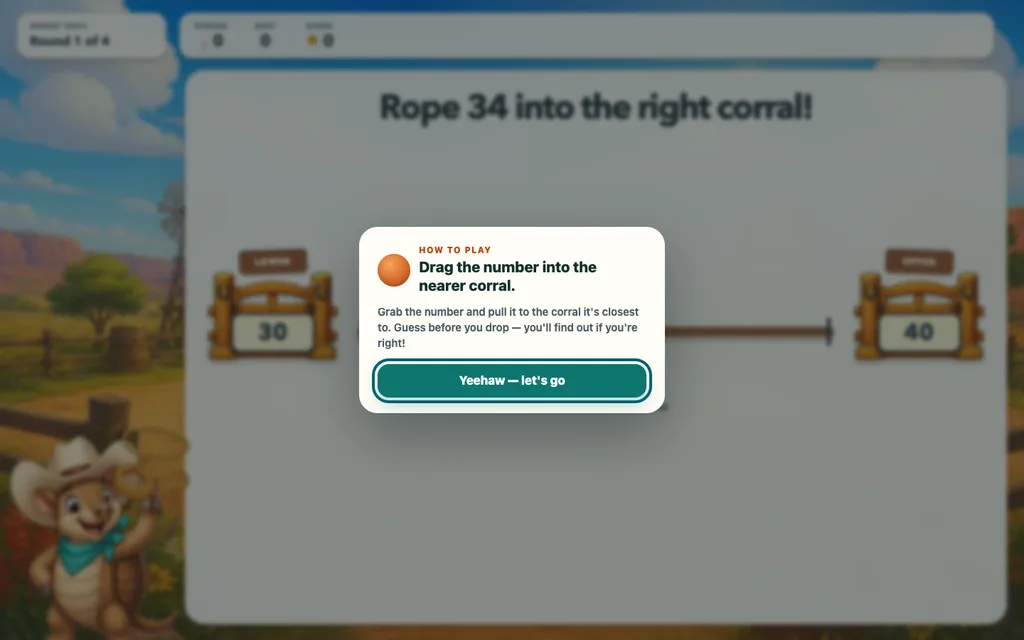
Rounding Rodeo
To round a number, place it between two neighbouring round numbers and choose the closer one; an exact midpoint rounds up.
What your child will figure out
- Locate a whole or decimal number between its two neighbouring multiples, then commit to a corral before seeing the distance explanation.
- Use distance from the midpoint to round whole numbers from the nearest 10 through the nearest 100,000.
- Apply the midpoint-up rule when a number sits exactly halfway between two choices.
- Transfer the same number-line reasoning to measurements, money, attendance, and decimals through thousandths in adaptive mixed practice.
The levels
- First catch
Rope 34 into 30, then see why the lower tens corral was nearer.
- Bigger herd
Round the larger number 146 to its nearer ten without extra prompts.
- Hundred herd
Scale the same physical number-line move to round 267 to the nearest hundred.
- Halfway showdown
Recognize that 35 sits exactly halfway and use the convention that halfway rounds up.
- Close-call canyon
Round 1,249 to the nearest hundred when it sits just below the midpoint.
- Hundred halfway
Apply halfway-up at a larger scale by rounding 6,550 to the nearest hundred.
- Thousand trail
Round an arena crowd of 14,499 to the nearest thousand.
- Grand midpoint
Use the midpoint convention to round 38,500 to the nearest thousand.
- Ten-thousand stampede
Round a herd count of 67,249 to the nearest ten thousand.
- Big arena estimate
Round an attendance estimate of 384,999 to the nearest hundred thousand.
- Whole-mile marker
Round a 12.46 km trail measurement to the nearest whole kilometre.
- Tenths turn
Round a supply weight of 8.74 kg to the nearest tenth.
- Hundredths hitch
Round a $42.195 supply cost to the nearest hundredth using halfway-up.
- Precision finals
Round a 7.3055 km course time to the nearest thousandth using the same midpoint rule.
Ready when they are.
Play Rounding Rodeo free — no account, no card.
Play Rounding Rodeo free