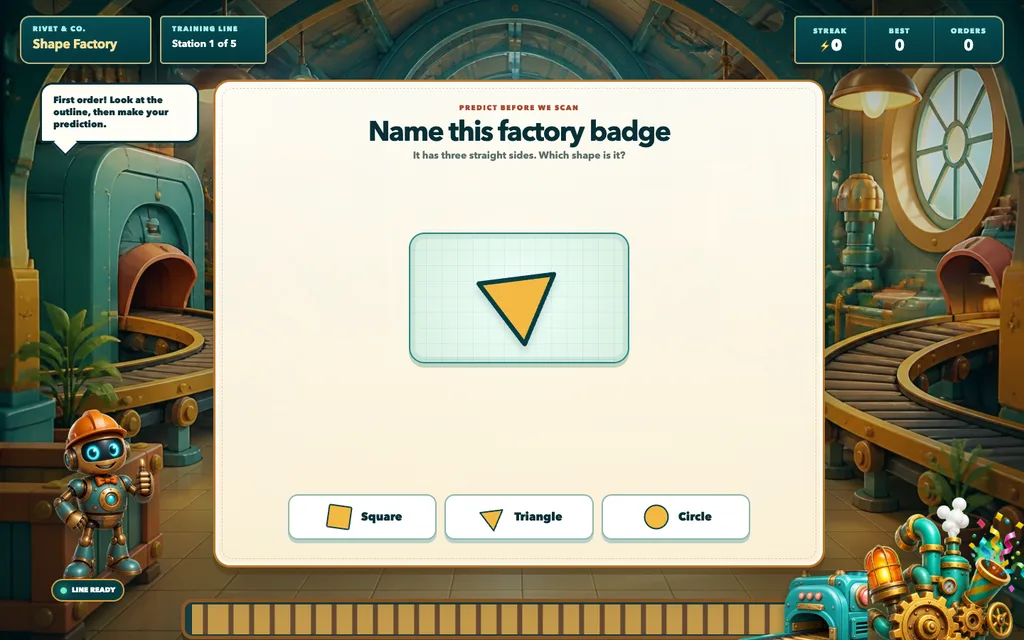
Shape Factory
A shape is identified by its structure: 2D shapes have sides and vertices, while 3D solids have faces, edges, and vertices; a valid net folds so its faces meet exactly once.
MathematicsAges 6-11~10 min🎙️ Voice tutor
Play freeNo account needed
What your child will figure out
- Name common 2D shapes and 3D solids from their defining structure rather than colour or orientation.
- Count sides and vertices on 2D shapes and faces, edges, and vertices on 3D solids.
- Predict which flat net folds into a named solid and explain how its faces meet.
- Solve endless generated geometry challenges while the adaptive staircase responds to evidence from each tracked skill.
The levels
- Badge scanner
Predict and identify a turned 2D shape by its boundary, then explain that orientation does not change its name.
- Property press
Use sides and vertices to select the only shape with four equal sides.
- Solid assembly
Connect a solid's visible surfaces to its name in a new 3D station.
- Inspection booth
Count a cube's faces, edges, and vertices as different structural features.
- Fold-test transfer
Transfer shape properties to a novel flat arrangement and identify the net that folds into a cube without overlap.
Ready when they are.
Play Shape Factory free — no account, no card.
Play Shape Factory free