Biome Explorer
A biome's long-term temperature and rainfall shape its vegetation, which determines which plants, animals, and food chains can survive there.
What your child will figure out
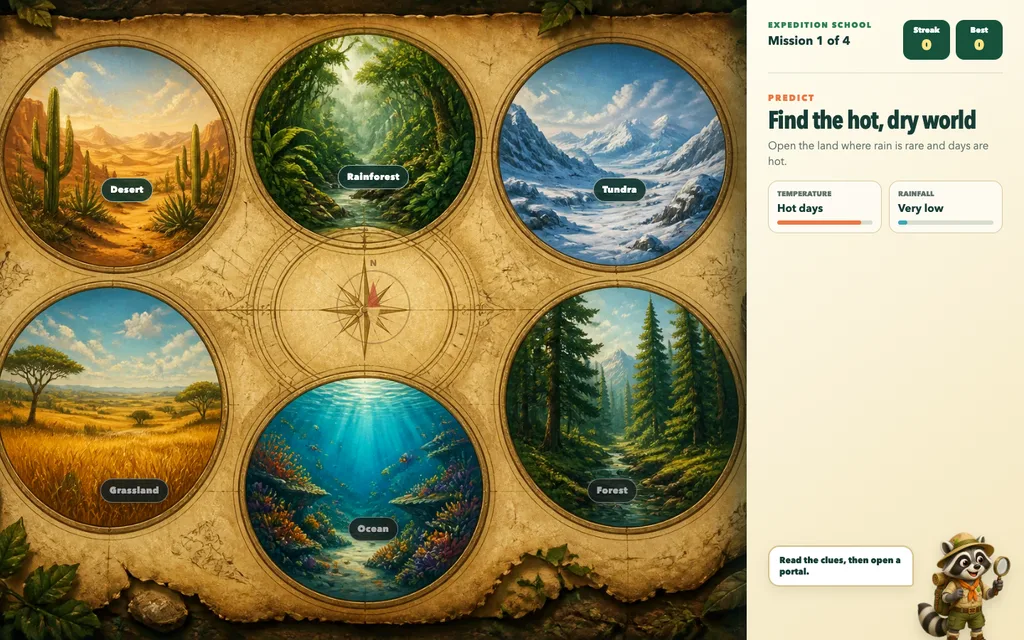
- Identify desert, rainforest, tundra, grassland, ocean, and forest from visible landscape and climate evidence.
- Match plants and animals to the biome where their adaptations meet climate and habitat conditions.
- Use temperature and rainfall together to distinguish biomes rather than relying on one surface cue.
- Build a simple producer-to-consumer food chain inside a suitable biome and continue with adaptive generated practice.
The levels
- Hot, dry world
Predict and identify the desert from low rainfall and high temperature evidence.
- Toucan relocation
Act by placing a toucan where warmth, heavy rain, tall trees, and fruit support it.
- Frozen signal
Observe both climate measures and explain why freezing, dry, treeless land is tundra.
- Forest chain
Transfer the biome model by building an oak-to-deer producer-consumer chain in a suitable forest.
- Saltwater signal
Identify the ocean as a biome whose conditions change with depth.
- Hollow trunks
Connect a woodpecker's feeding and nesting adaptations to forest structure.
- Desert energy
Reapply the producer-consumer model with a cactus-to-camel desert chain.
- Two forests
Distinguish rainforest from seasonal forest using warmth, rainfall, and canopy evidence.
- Low on the tundra
Use plant form as evidence by matching low-growing arctic moss to tundra.
- Grazing energy
Reinforce energy transfer with a grass-to-zebra grassland chain.
- Changing canopy
Synthesize rainfall and seasonal temperature evidence to identify temperate forest.
- Ocean transfer
Transfer the producer-consumer model by building a kelp-to-sea-turtle ocean chain.
Ready when they are.
Play Biome Explorer free — no account, no card.
Play Biome Explorer free