The whole lesson library
101 ways to learn by doing.
Pick a topic and jump into a hands-on game. Kids predict, build, test and explain while Ako coaches the next thought out loud.
Ages 4–13
Find their next obsession
What are they curious about?
Choose a topic to jump straight to its lessons.
Browse every lesson
Choose something to try
Every card opens a real interactive lesson—not a worksheet or a quiz dressed up as a game.
Maths
Numbers, shapes and problem solving
 Gator Chomp
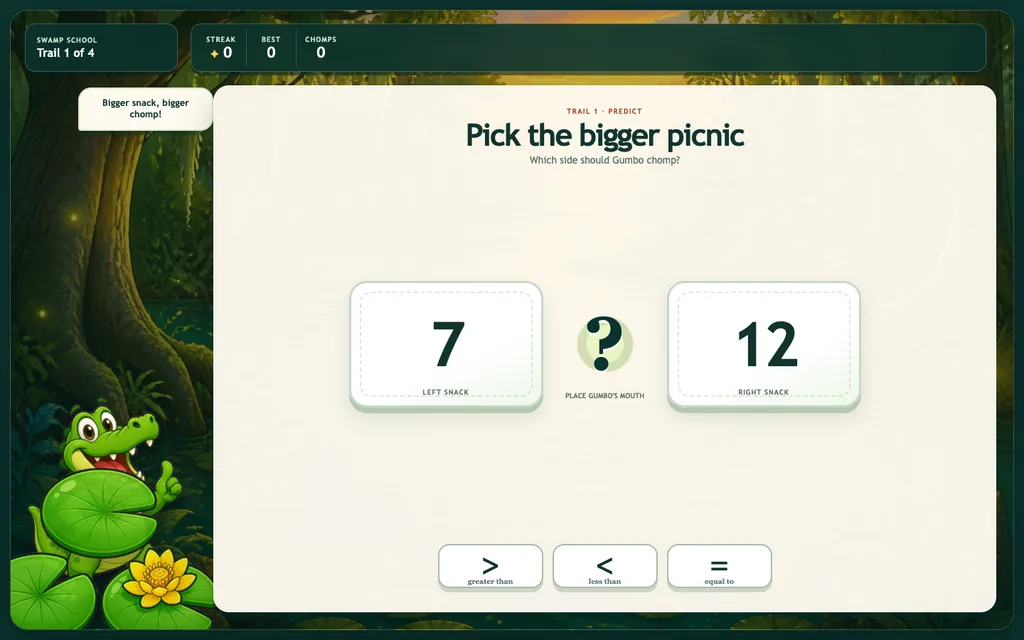
The symbols > and < open toward the greater value, while = shows equal values; comparing place values lets us use the same relationship for whole numbers, decimals, fractions, and ordered sets.
Open lesson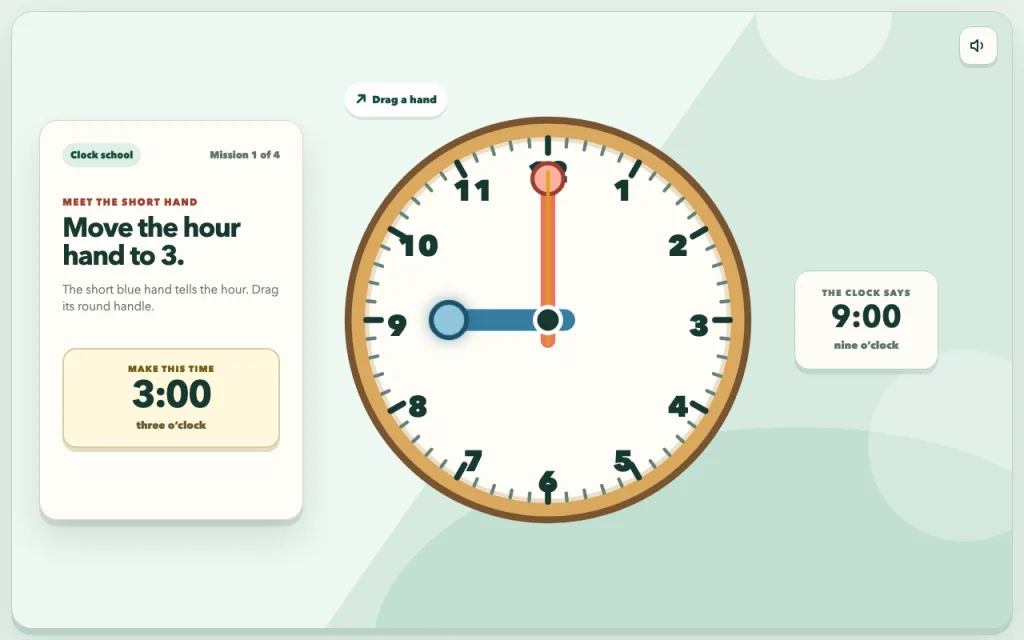 Clock Workshop
A clock’s short hand points to the hour and its long hand points to the minutes; reading both hands together tells the time.
Open lesson Clock QuestThe short hand shows the hour and the long hand counts minutes around the clock; reading or setting both hands together makes one exact time.
Open lesson Times Table ArenaA multiplication fact counts equal groups: a × b is a equal rows with b in each row, and the product is the total across every row.
Open lesson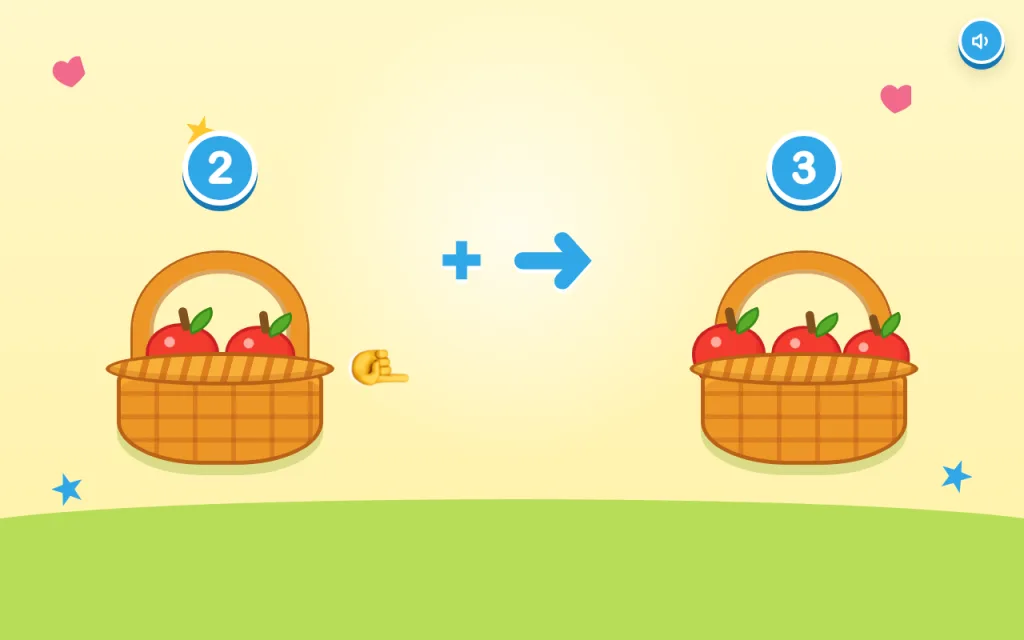 Apple Add
Adding means putting groups together and counting every object in the new whole group.
Open lesson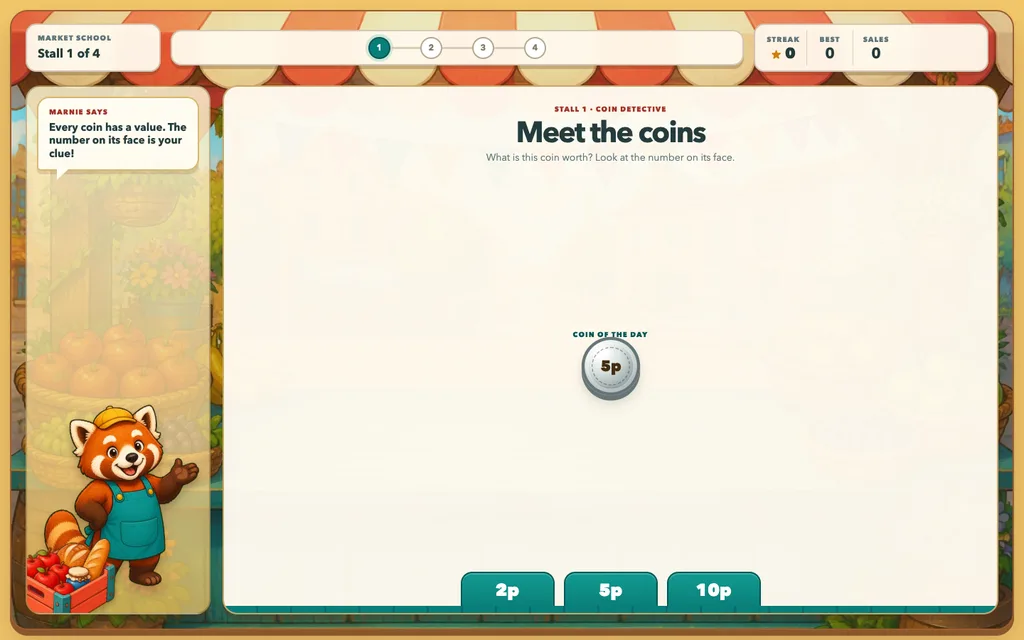 Money Market
Money amounts are totals of coin and note values; exact payment matches a price, while change is the difference between what was paid and what it cost.
Open lesson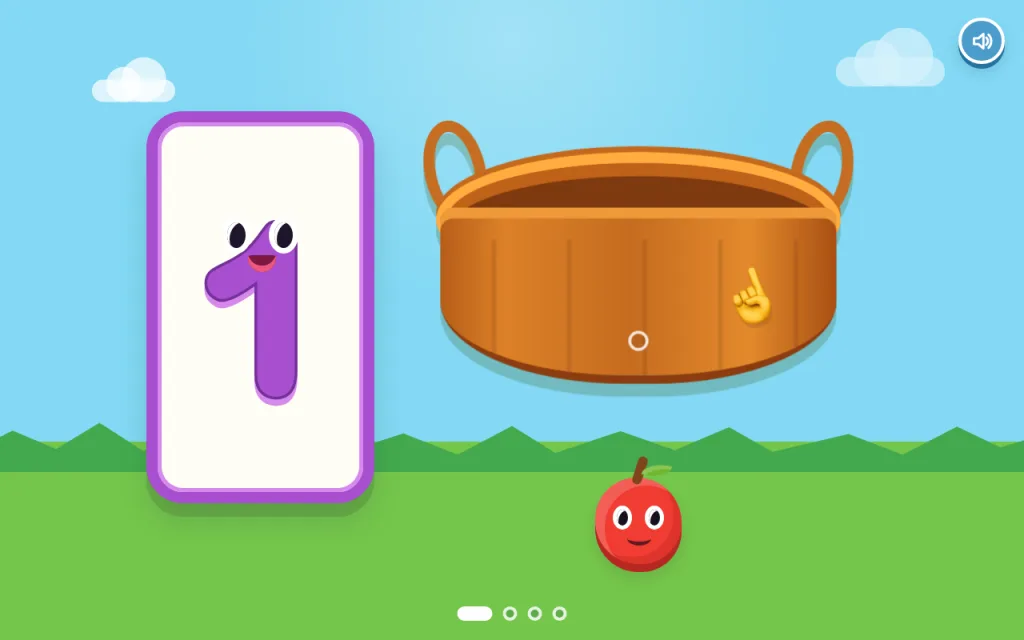 Number Friends
Each numeral stands for an amount: the numeral 3 means three things.
Open lesson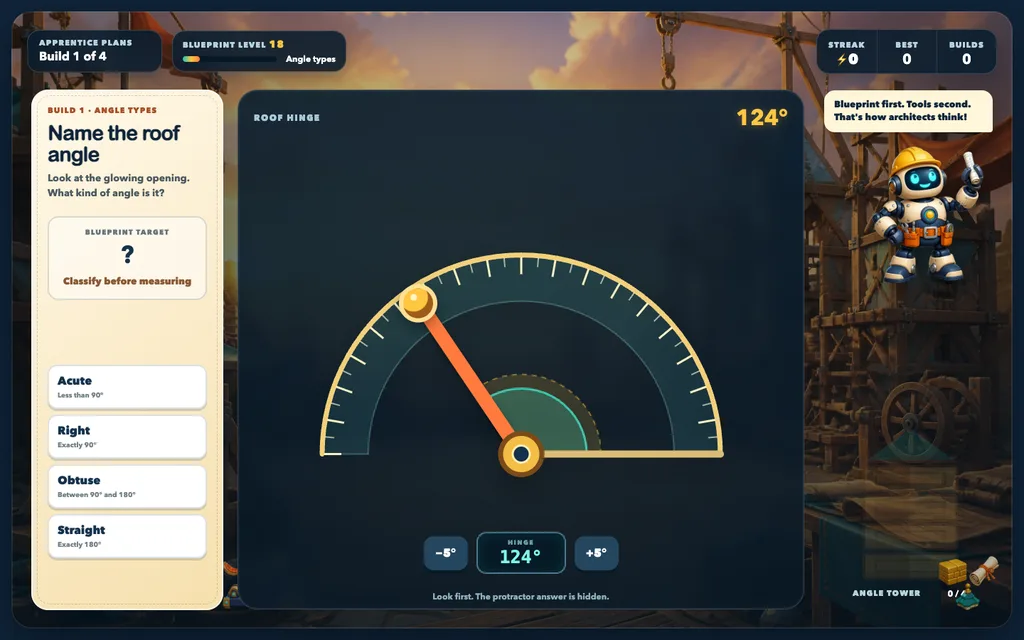 Angle Architect
An angle measures the amount of turn between two rays: angles range from acute through reflex, a protractor reads the inside turn from 0° to the degree, and missing angles can be found from 90°, 180°, and 360° totals.
Open lesson Area & Perimeter ParkArea counts the square units inside a shape, while perimeter measures the unit lengths around its outside boundary; equal areas can have different perimeters.
Open lesson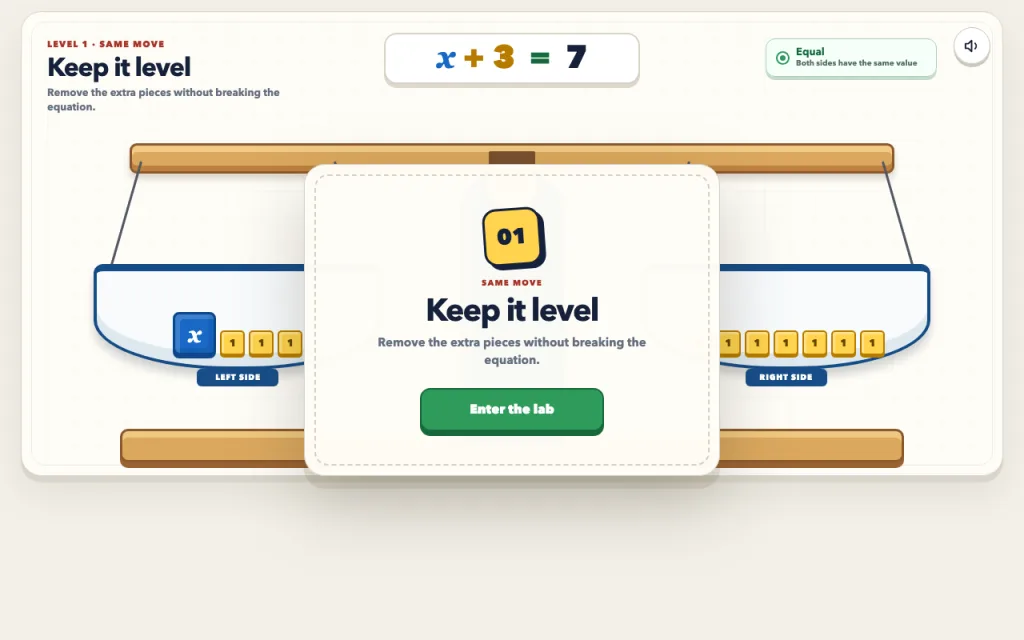 Balance Lab
An equation is a balance: doing the same thing to both sides keeps it equal and can isolate x, while unequal changes break equality.
Open lesson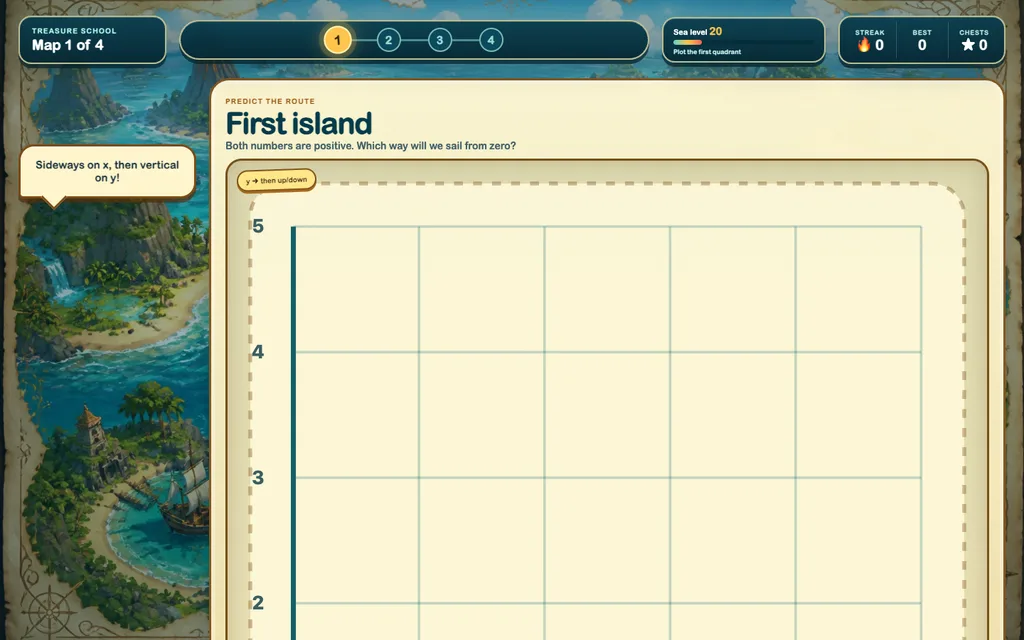 Coordinate Quest
A coordinate pair (x, y) gives an exact location: move horizontally along x first, then vertically along y; negative values reverse the direction from the origin.
Open lesson Counting Critters
Counting tells how many: give each thing exactly one number, and the last number counted is the total.
Open lesson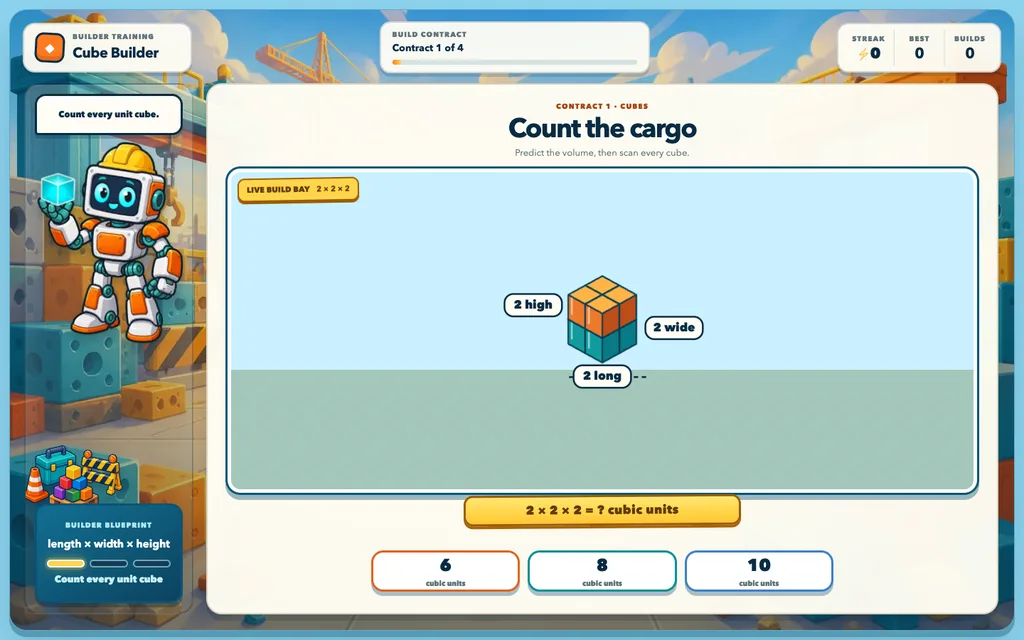 Cube Builder
Volume is the number of unit cubes that fill a three-dimensional solid; equal layers show why length × width × height counts every cube inside.
Open lesson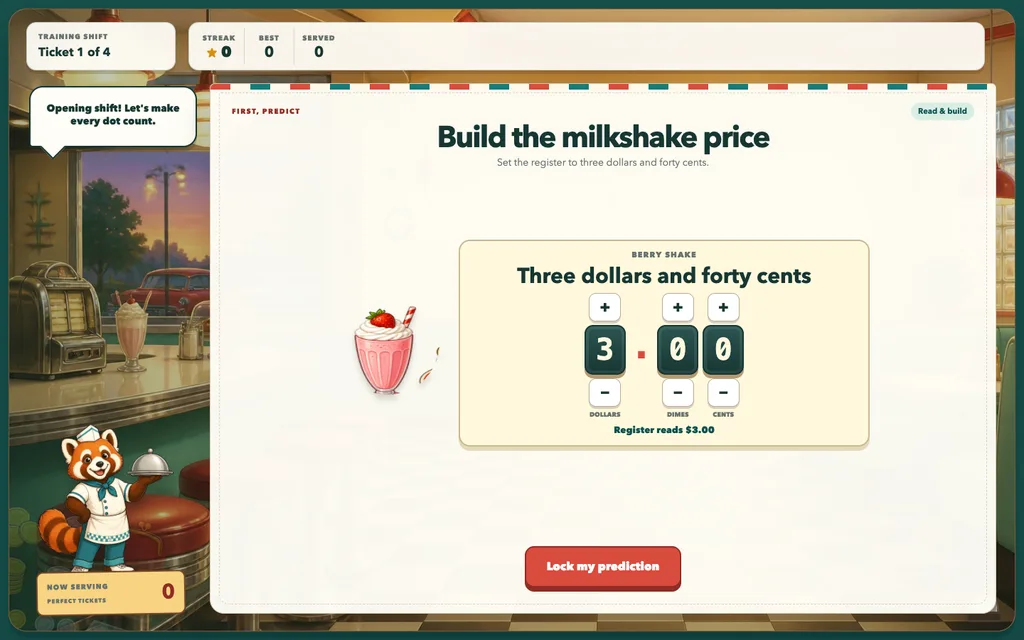 Decimals Diner
A decimal point anchors place value: decimals can be read, located, compared, rounded, scaled, added, and subtracted by tracking what every place is worth.
Open lesson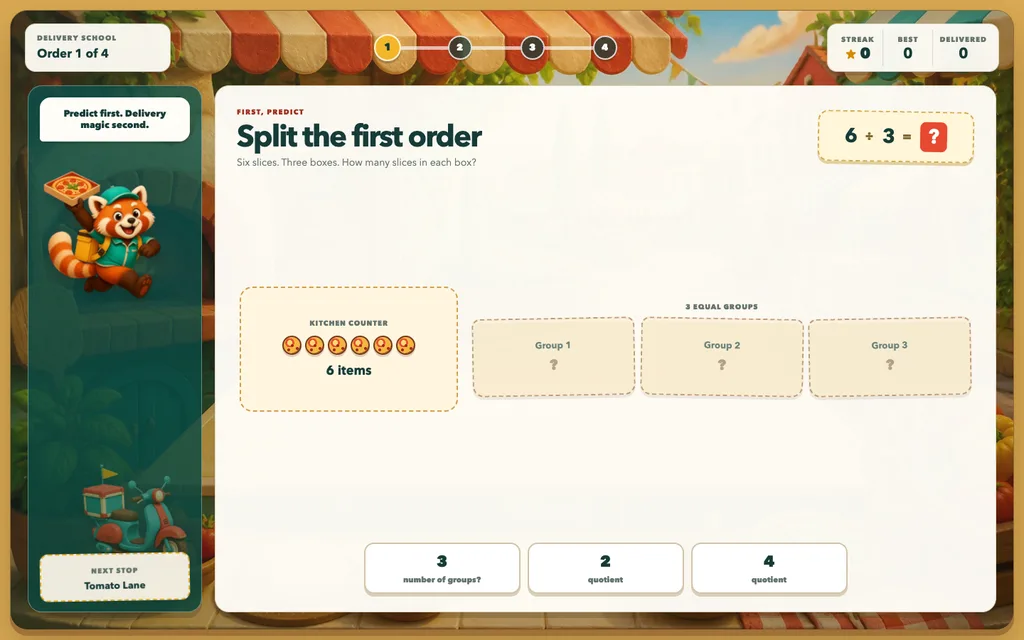 Division Dash
Division shares a total equally: the quotient tells how many belong in each group (or how many equal groups can be made), and any amount left over is the remainder.
Open lesson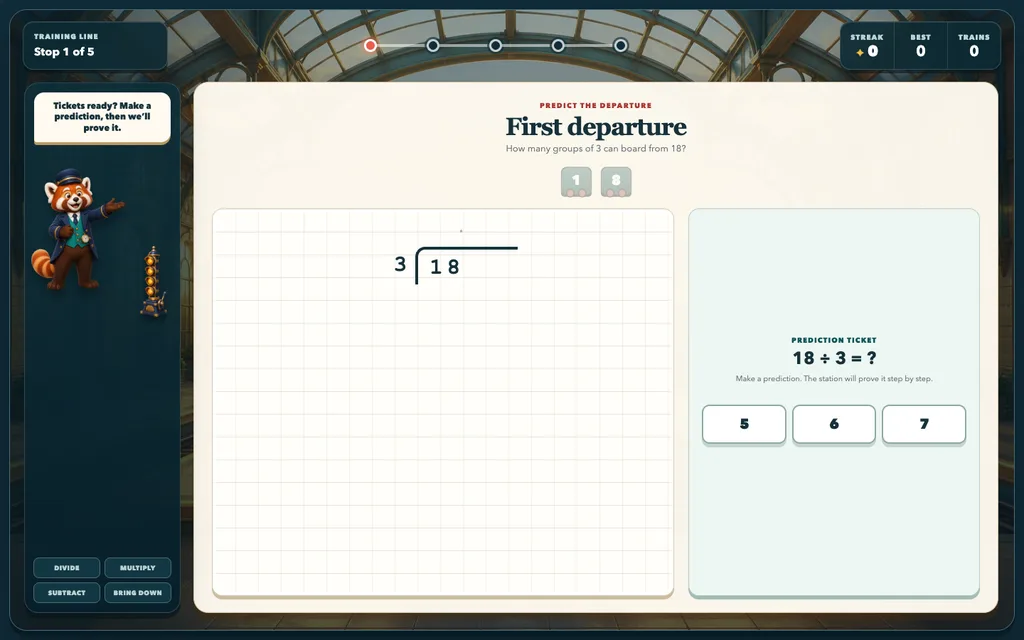 Division Station
Long division repeats divide, multiply, subtract, and bring down; each cycle fixes one quotient digit, and the final leftover is a remainder smaller than the divisor.
Open lesson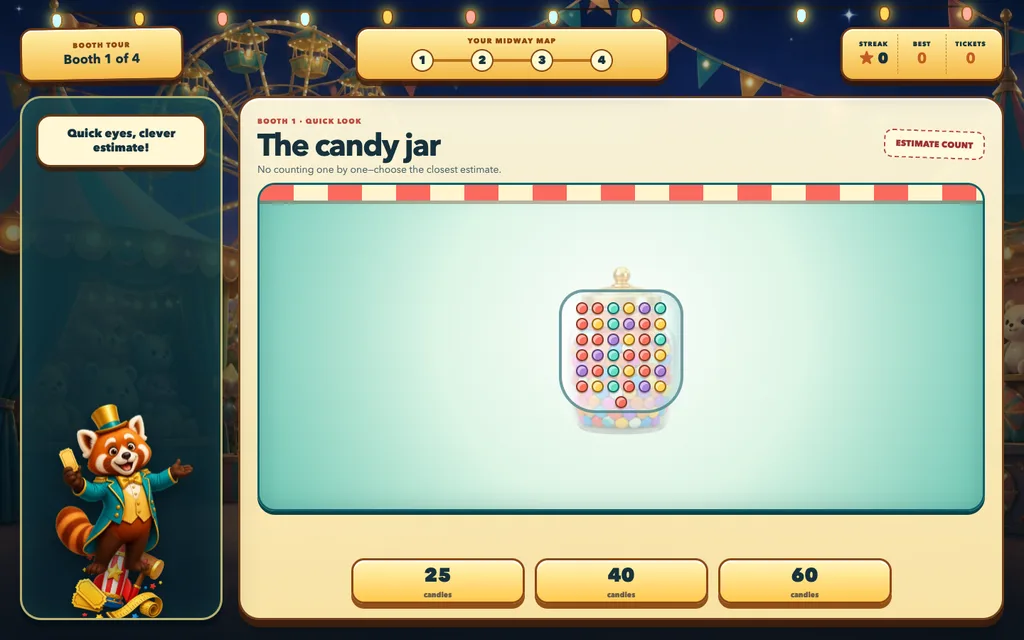 Estimation Station
A useful estimate is a nearby, quick answer made with groups, familiar benchmarks, or rounded numbers; comparing it with the actual result helps us judge whether an answer is reasonable.
Open lesson Fraction FlipA fraction, decimal, and percent can name the same amount; equivalent forms fill exactly the same length of one whole.
Open lesson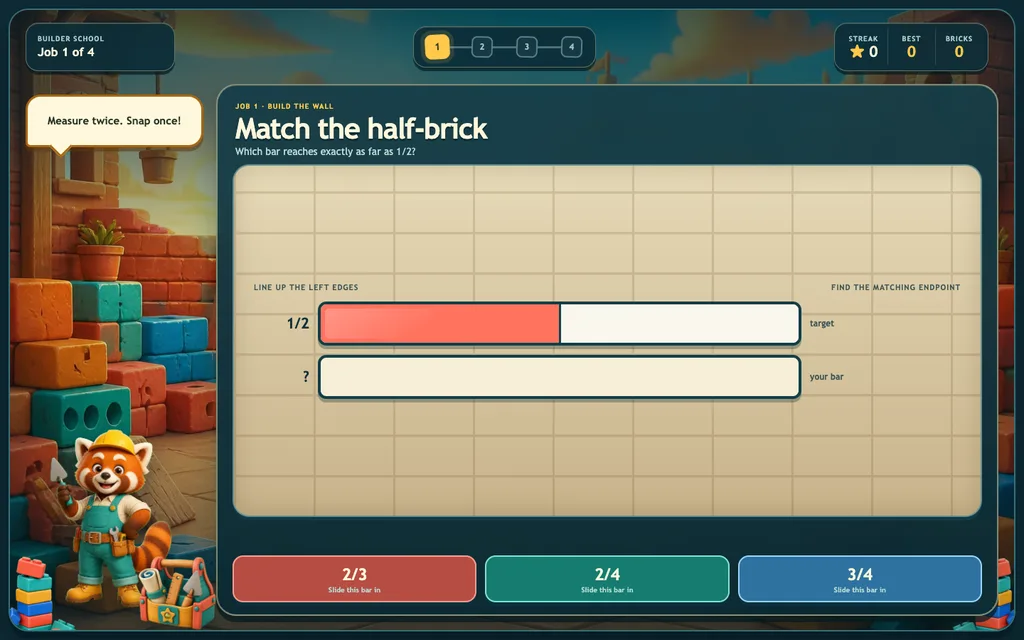 Fraction Wall
Fractions are equivalent when they cover the same length of the same whole; lining bars up makes equivalence, comparison, and simplification visible.
Open lesson Grid RangerAn ordered pair (x, y) names one exact point by giving a horizontal x move from the origin first, followed by a vertical y move; negative values reverse those directions.
Open lesson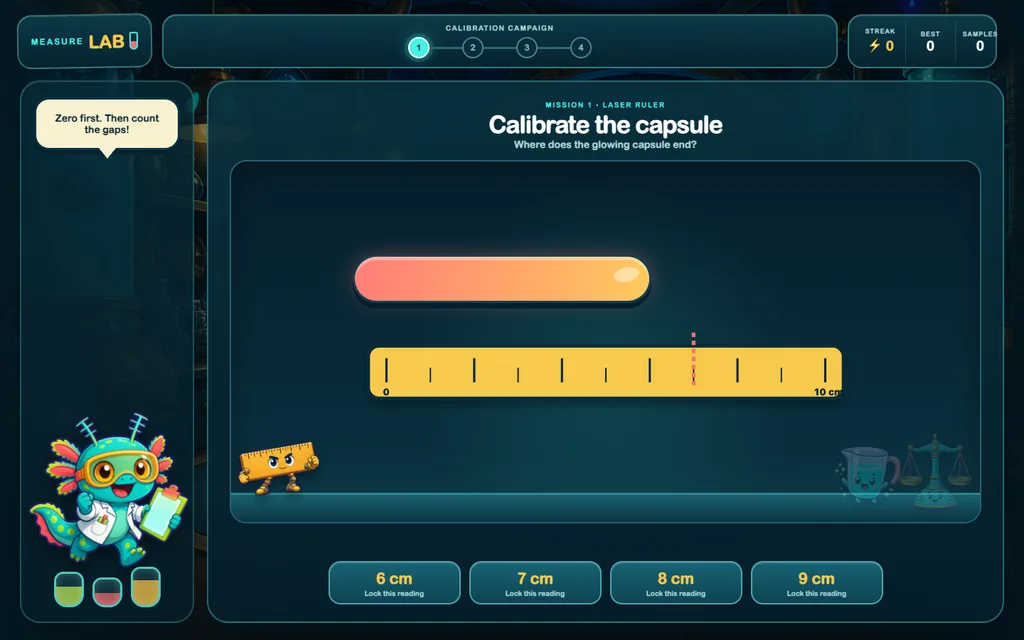 Measure Lab
Measurements pair a number with a unit; instrument marks show equal intervals, and converting units changes the number without changing the amount.
Open lesson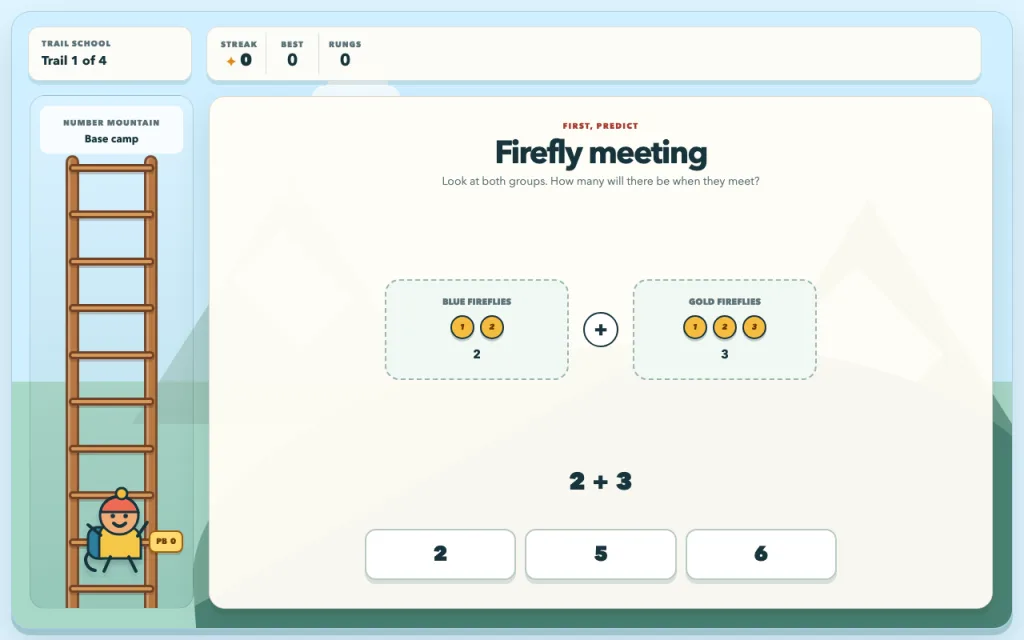 Number Ladder
Adding combines every member of two or more groups into one total; the groups change arrangement, but no members disappear.
Open lesson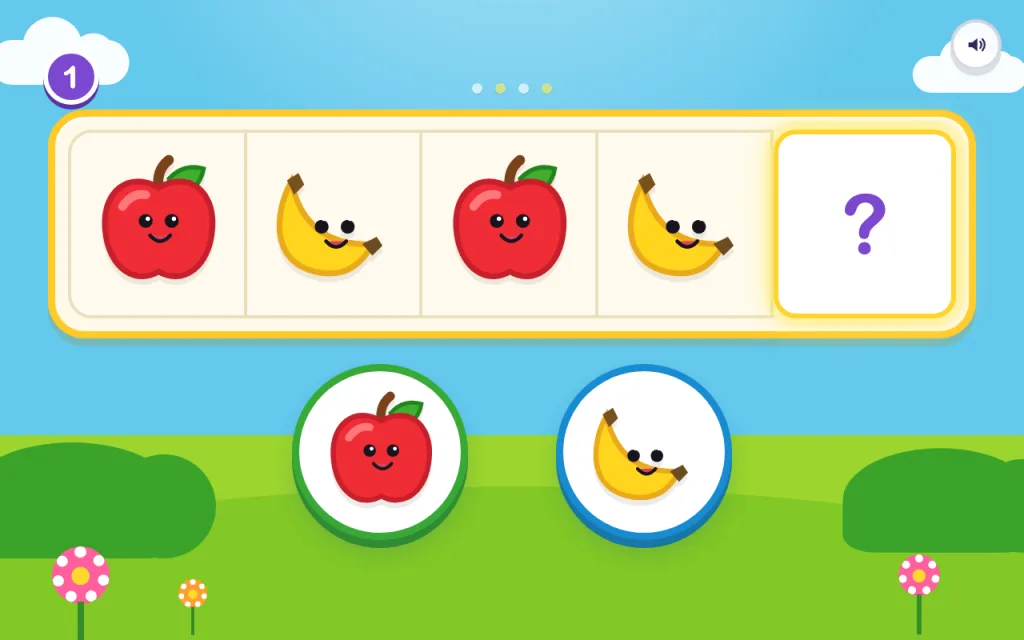 Pattern Party
A pattern repeats; once you spot the repeat, it tells you what comes next.
Open lesson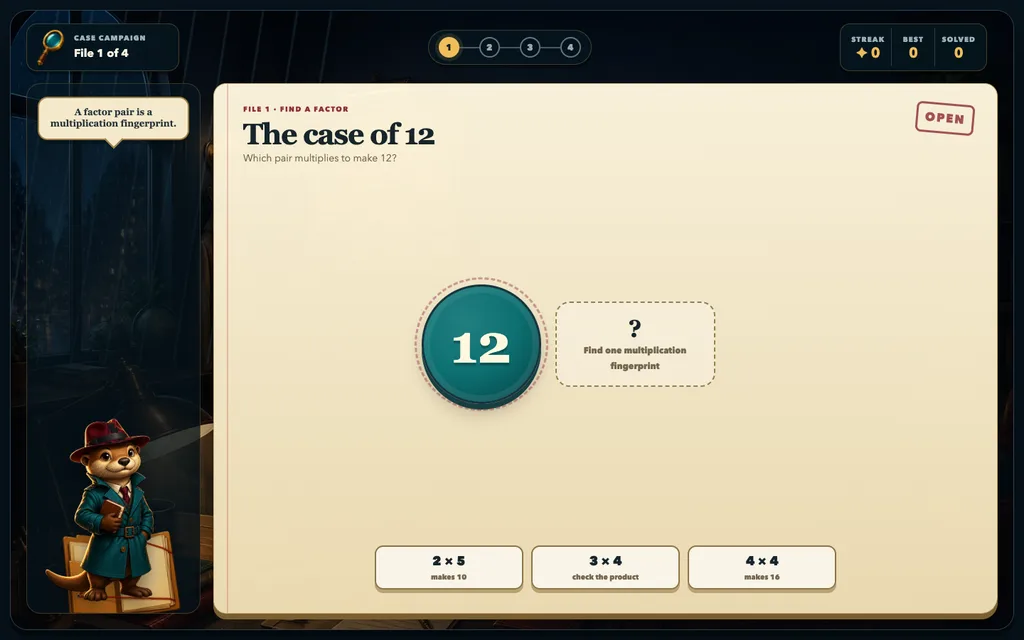 Prime Detective
A prime number has exactly two factors, 1 and itself; a composite number has additional factor pairs, which can be found by testing divisors only up to its square root.
Open lesson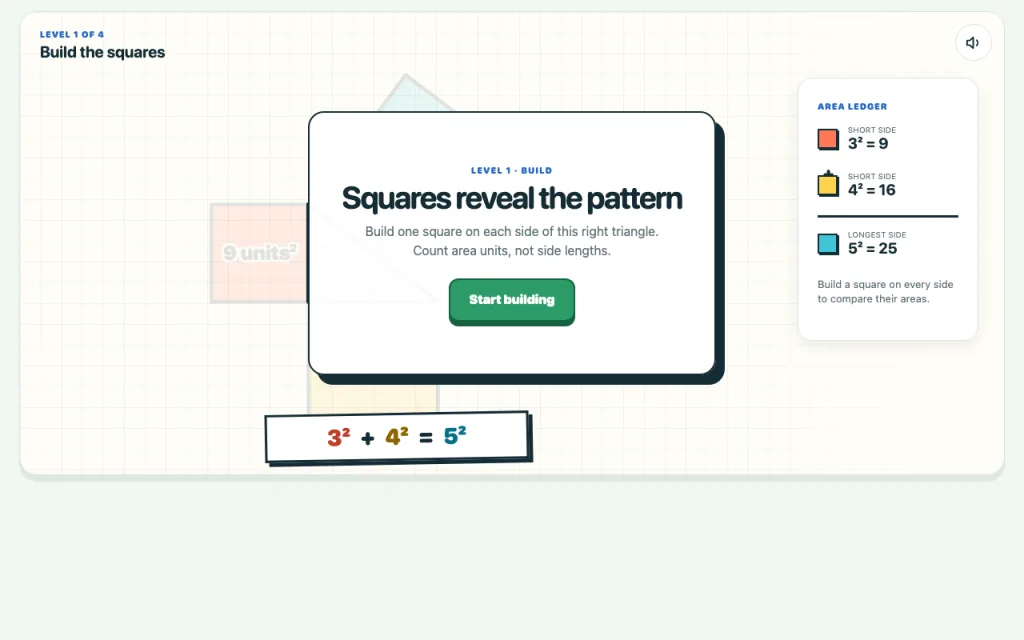 Pythagoras Builder
For a right triangle, the square areas on the two short sides together exactly equal the square area on the longest side: a² + b² = c².
Open lesson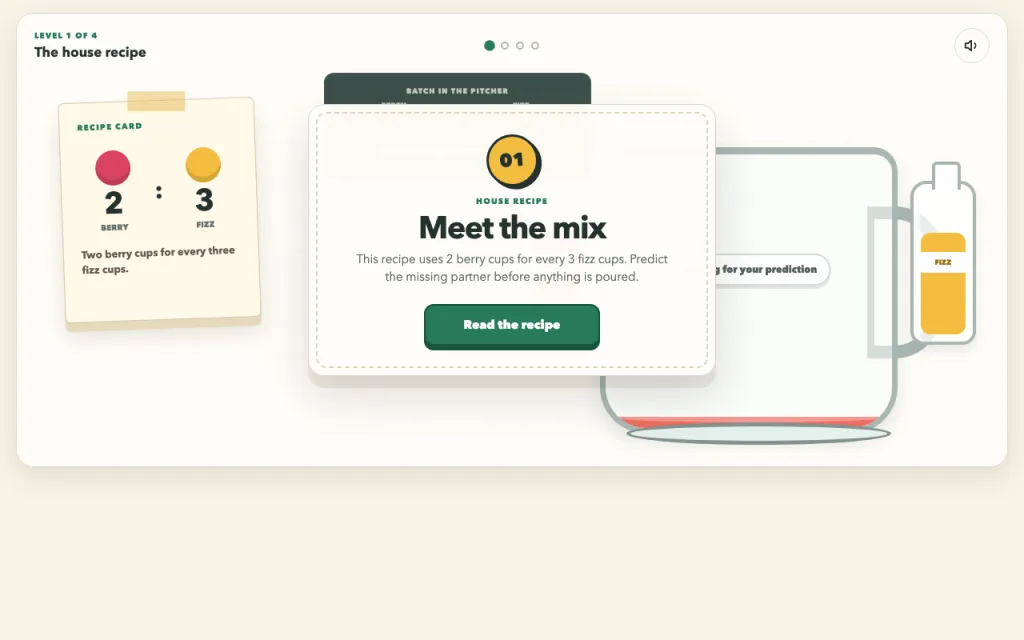 Ratio Recipe Mixer
A ratio stays the same when both quantities are scaled by the same factor, so equivalent ratios make the same mixture.
Open lesson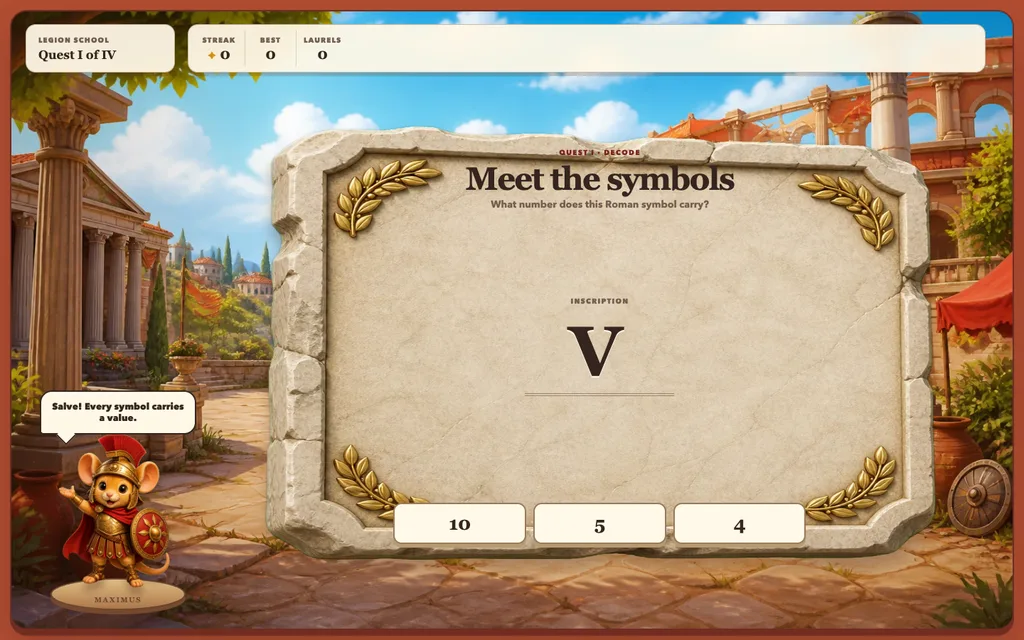 Roman Quest
Roman numerals use symbols with fixed values; reading from left to right usually adds them, but a smaller value before a larger value is subtracted.
Open lesson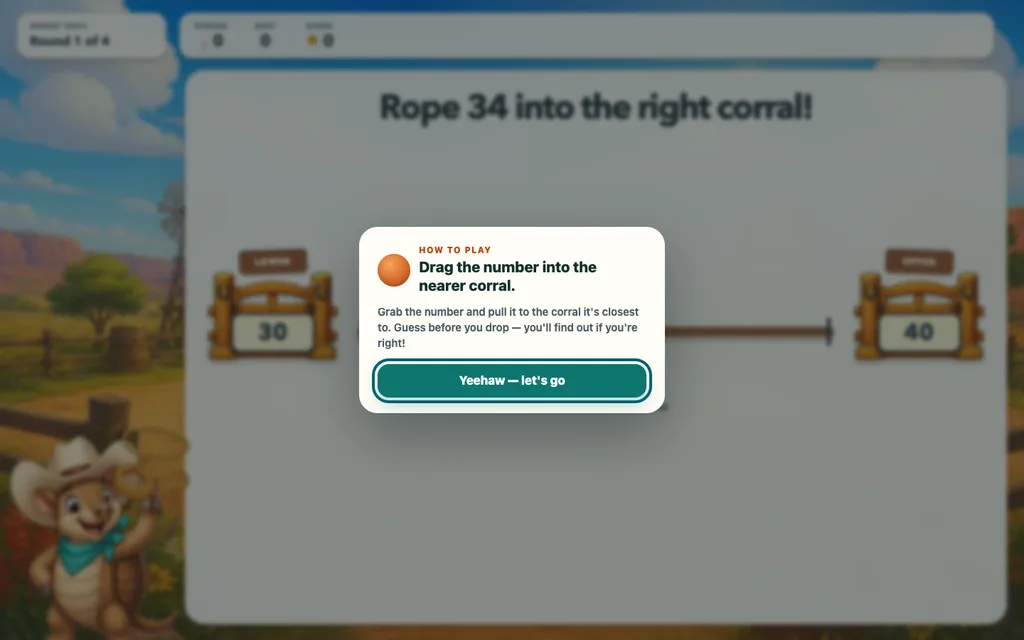 Rounding Rodeo
To round a number, place it between two neighbouring round numbers and choose the closer one; an exact midpoint rounds up.
Open lesson Shape SpaceA shape keeps its identity when it turns, changes size, or appears as an everyday object; its straight sides and corners identify a 2D shape, while faces, edges, vertices, and curved surfaces identify a 3D solid.
Open lesson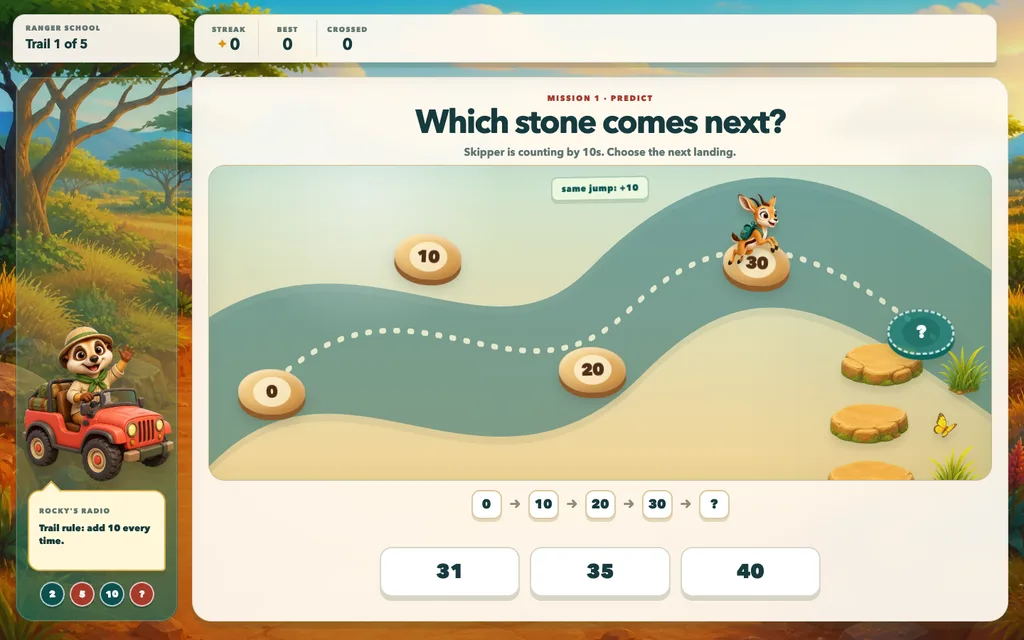 Skip Count Safari
Skip-counting makes equal jumps on the number line; each landing adds the same amount, so the number of jumps connects directly to multiplication.
Open lesson Slope Skatepark
Slope is steepness measured as rise divided by run: a bigger ratio is steeper, and equal ratios are equally steep.
Open lesson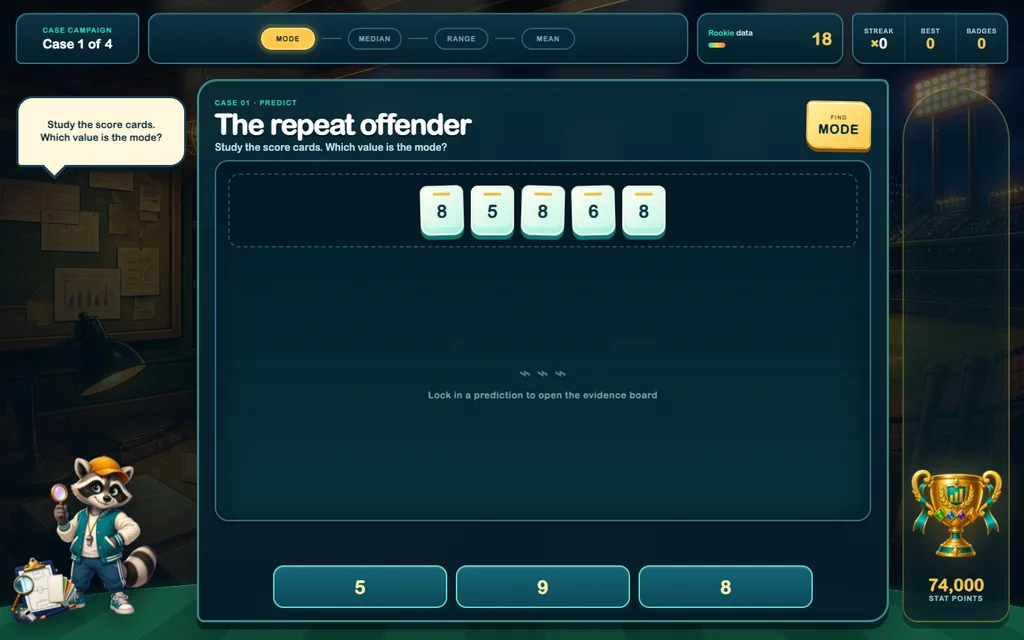 Stat Squad
Mean, median, mode, and range describe different features of the same data: equal share, ordered middle, most frequent value, and total spread.
Open lesson Story ProblemsThe action in a story tells us which operation connects its numbers; representing that action as a number sentence makes the answer explainable.
Open lesson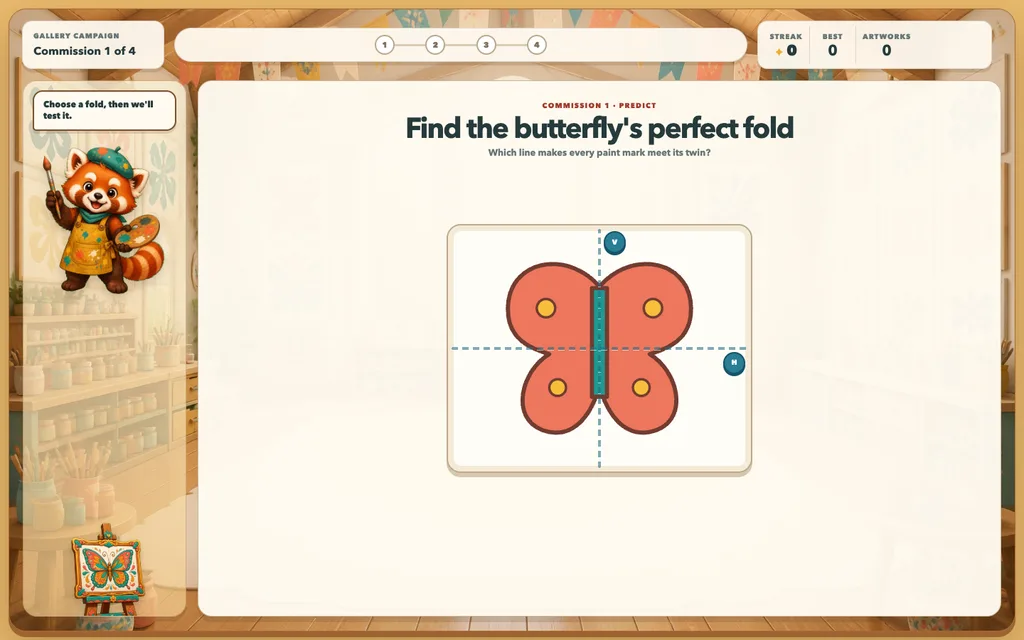 Symmetry Studio
A line of symmetry is a fold line that pairs every point with a matching point the same perpendicular distance on the other side; a shape can have none, one, or several such lines.
Open lesson Time Station
Elapsed time is how far a clock moves forward from a start time to an end time; counting on through friendly hour boundaries makes that journey visible and reliable.
Open lesson Vault Cracker
An equation is a balanced scale: doing the same move to both sides keeps it equal, and inverse operations isolate the unknown so its value can be revealed.
Open lesson Which Has More?
One group can have more, fewer, or the same number of things, and counting tells which for sure.
Open lessonScience
Experiments, nature, Earth and space
 Food Web Balance
Plants, plant-eaters and predators keep each other in check, so adding or removing one species ripples through the whole food web — even to species it never touches.
Open lesson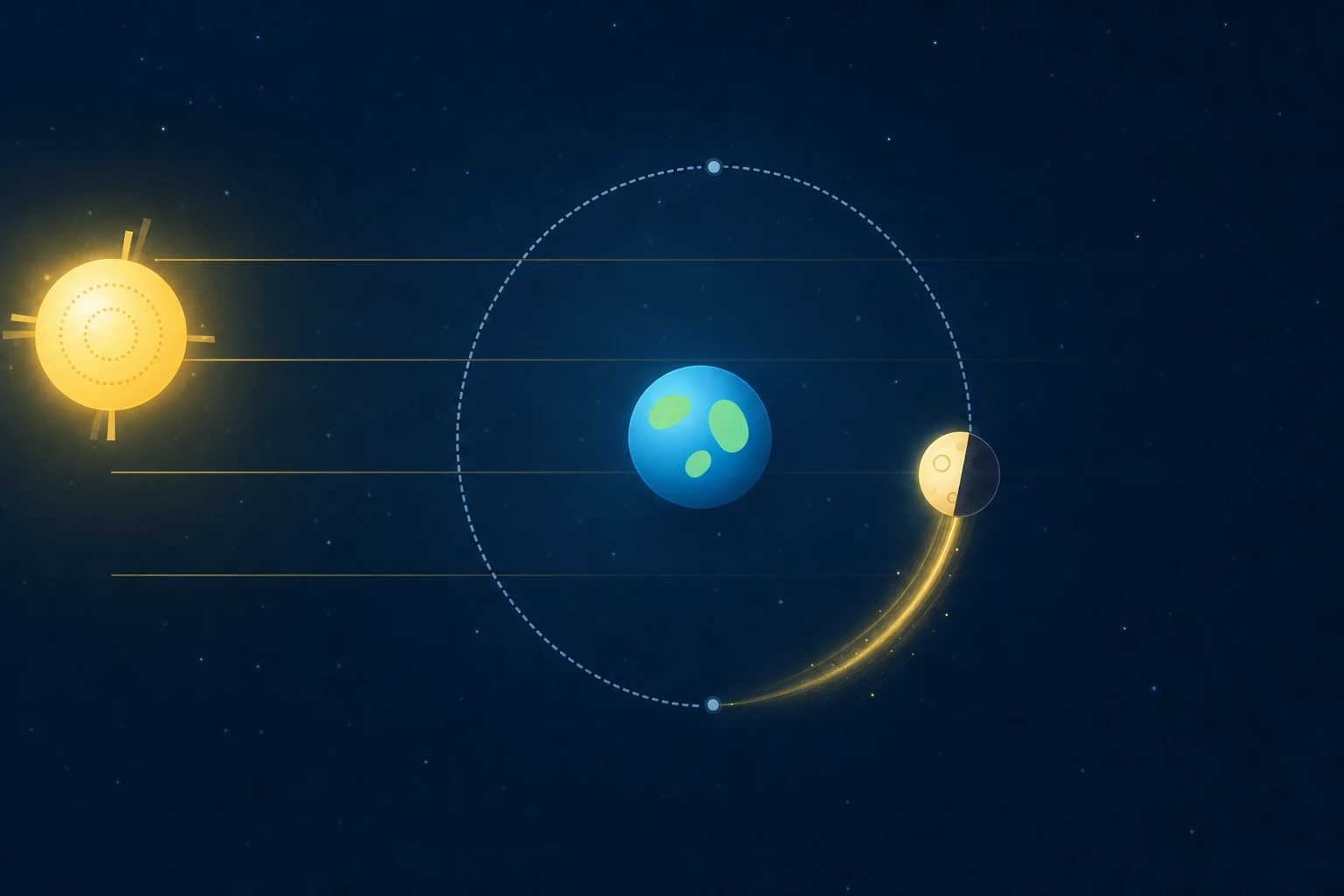 Moon Phases Lamp
The Sun always lights half the Moon; as the Moon moves around Earth, our changing view of that same lit half makes the phases repeat in order.
Open lesson Ocean Deep
The ocean changes in zones with depth: sunlight fades, temperature falls, and pressure rises, so animals need different adaptations to live at different depths.
Open lesson Live Fault TableEarthquakes occur when accumulated tectonic stress exceeds fault resistance; released energy depends on several source factors, P and S waves travel differently, and observed impact emerges through source, path, site, and structure.
Open lesson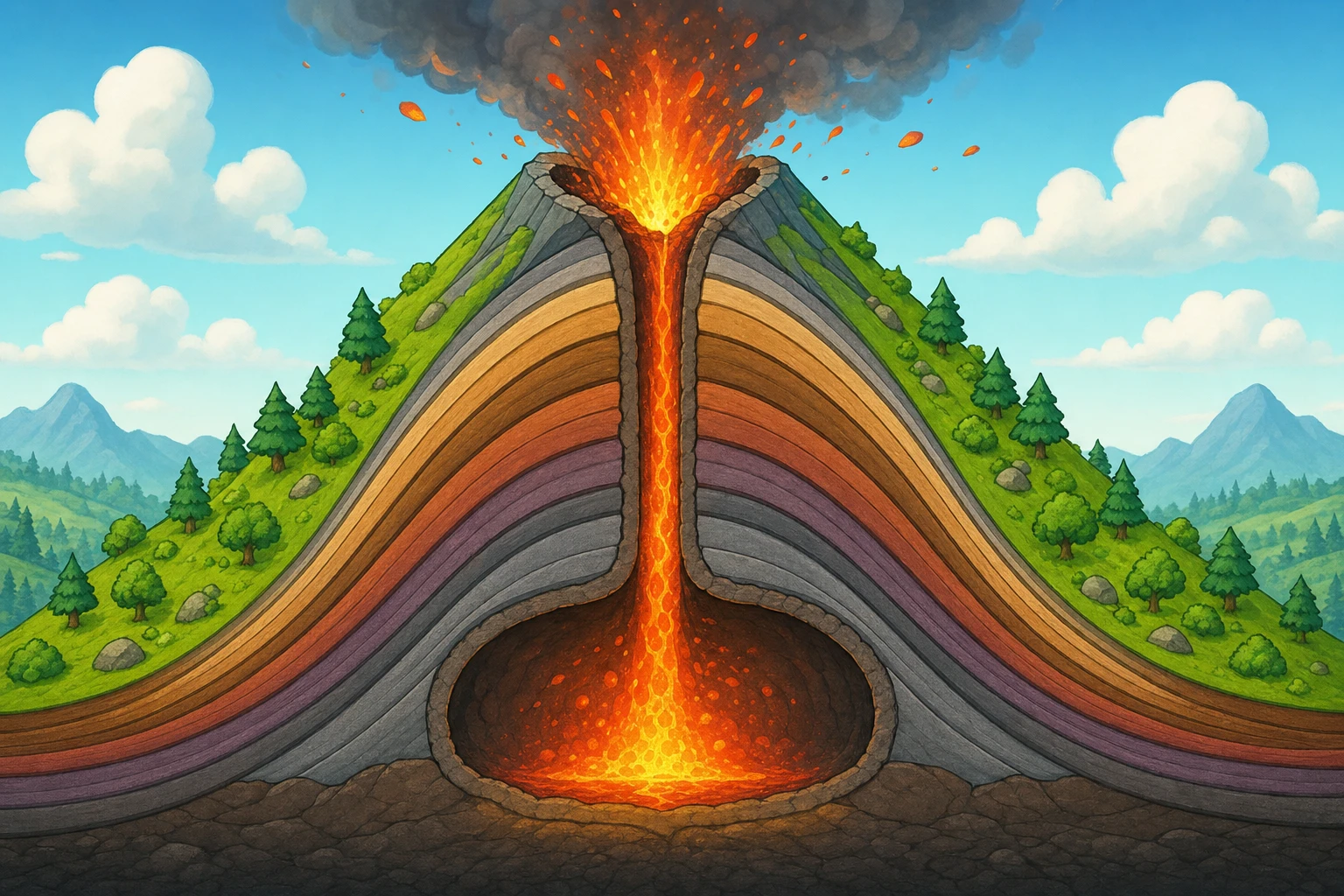 Volcano Inside
Heat and expanding trapped gas build pressure in a magma chamber; that pressure forces magma up a vent, and more stored pressure produces a bigger eruption.
Open lesson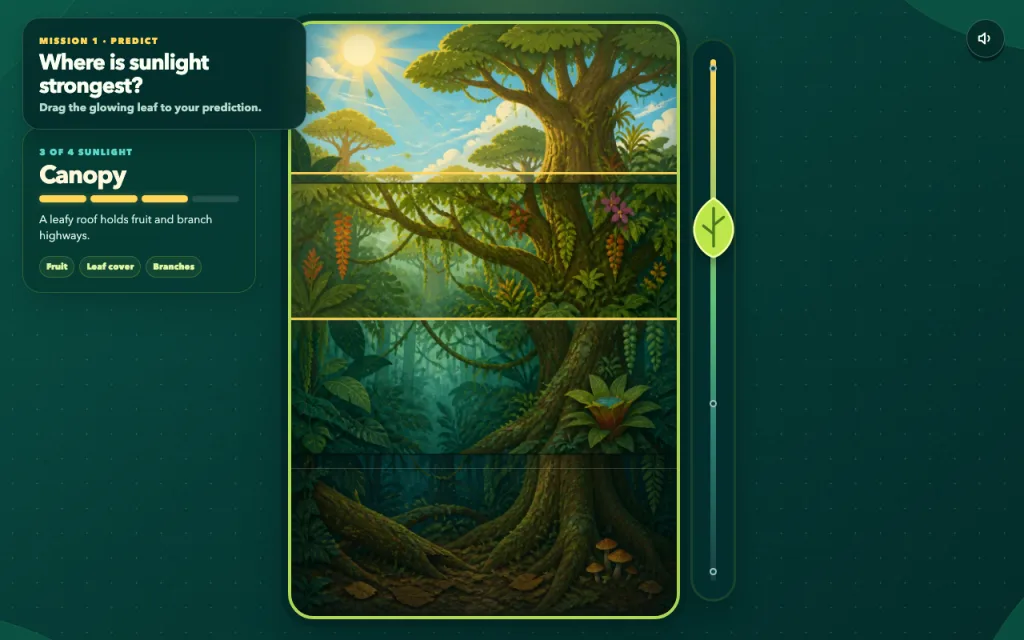 Rainforest Layers
A rainforest has four vertical layers, and different animals fit each layer because light, food, movement routes, moisture, and safety change from top to bottom.
Open lesson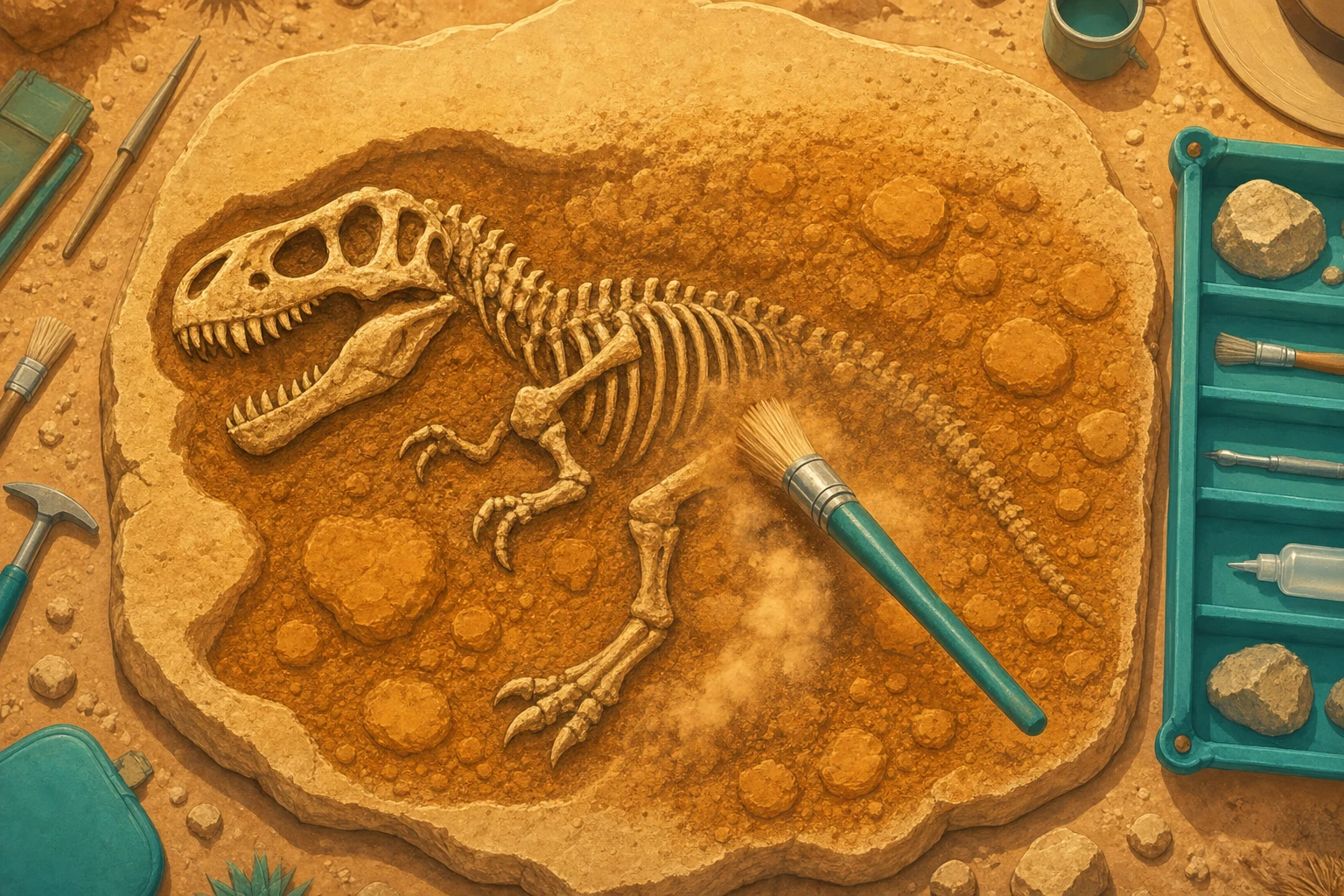 Fossil Dig
Fossils are clues preserved in rock; palaeontologists carefully uncover their shapes and positions, then fit that evidence together to infer what an extinct animal looked like.
Open lesson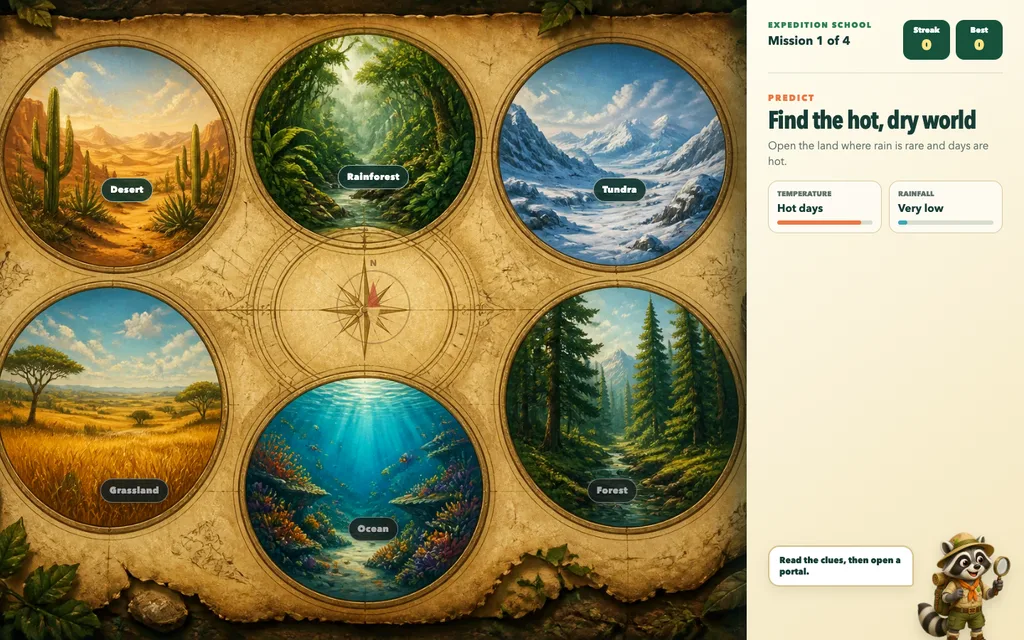 Biome Explorer
A biome's long-term temperature and rainfall shape its vegetation, which determines which plants, animals, and food chains can survive there.
Open lesson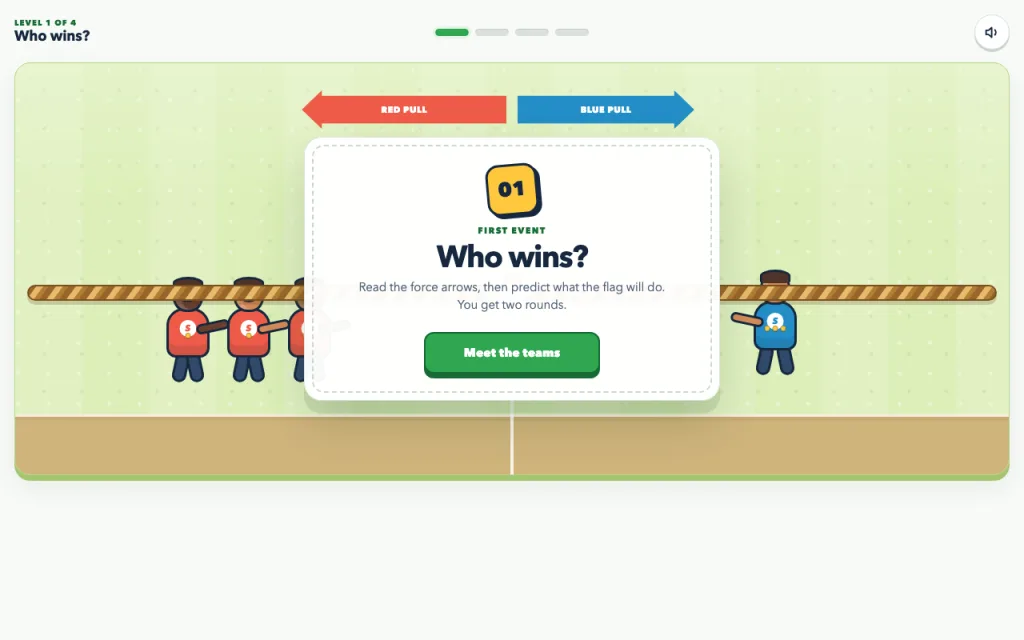 Forces Tug of War
Equal opposing forces balance and keep an object still; when one opposing force is bigger, the object moves in that force's direction, regardless of headcount.
Open lesson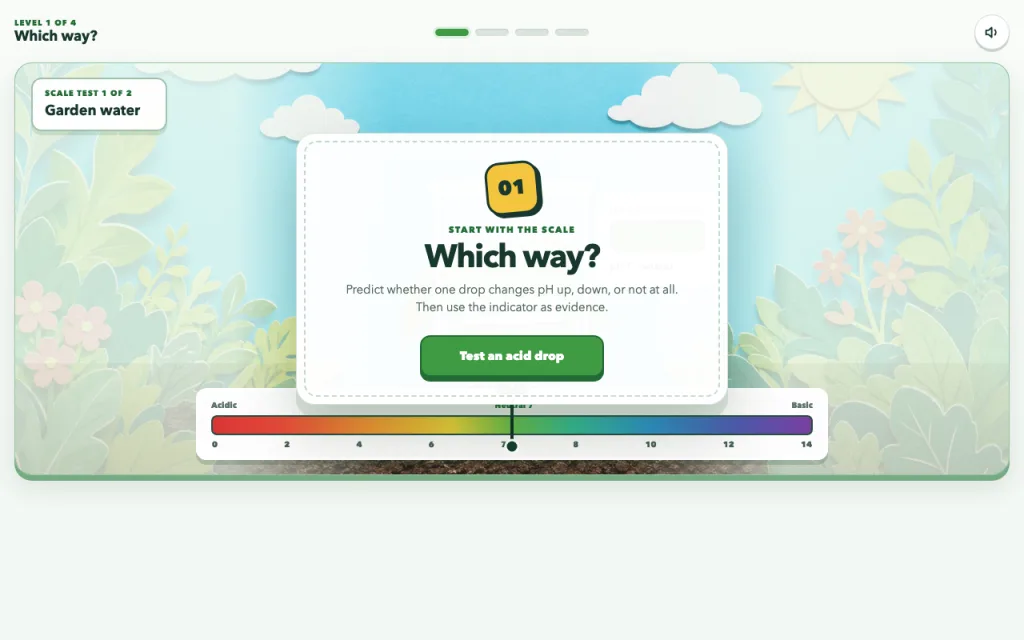 Acids and Bases Garden
pH measures how acidic or basic a solution is: acid lowers pH, base raises pH, and neutral is 7.
Open lesson Aotearoa BirdsAotearoa New Zealand’s native birds can be recognised respectfully by distinctive visible features such as bill shape, feather markings, body shape, legs, eyes, and tail.
Open lesson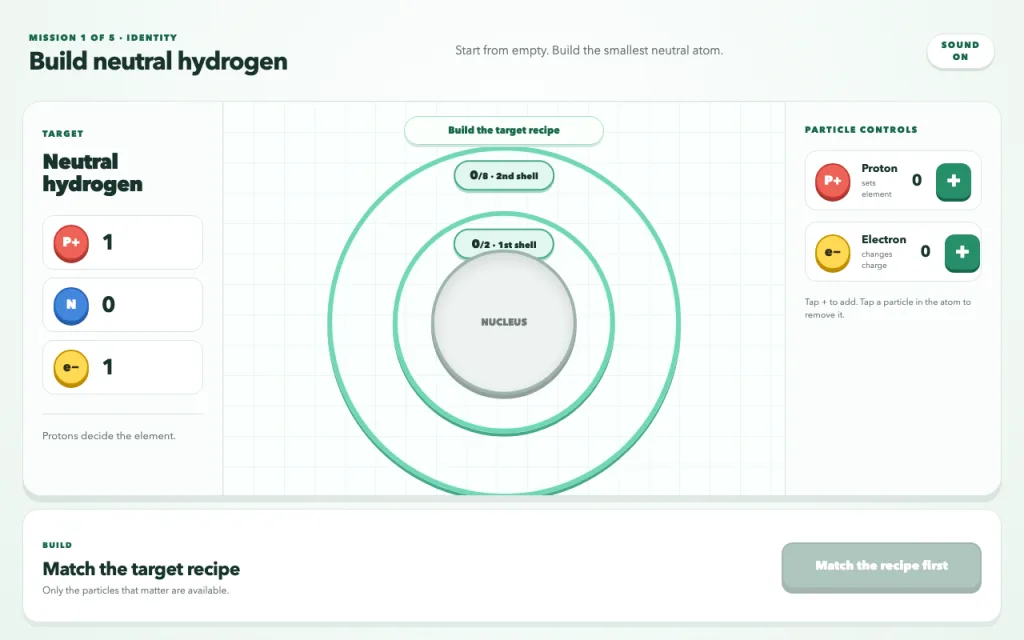 Atom Forge
Protons decide which element an atom is, neutrons change its isotope and mass, and electrons change its charge.
Open lesson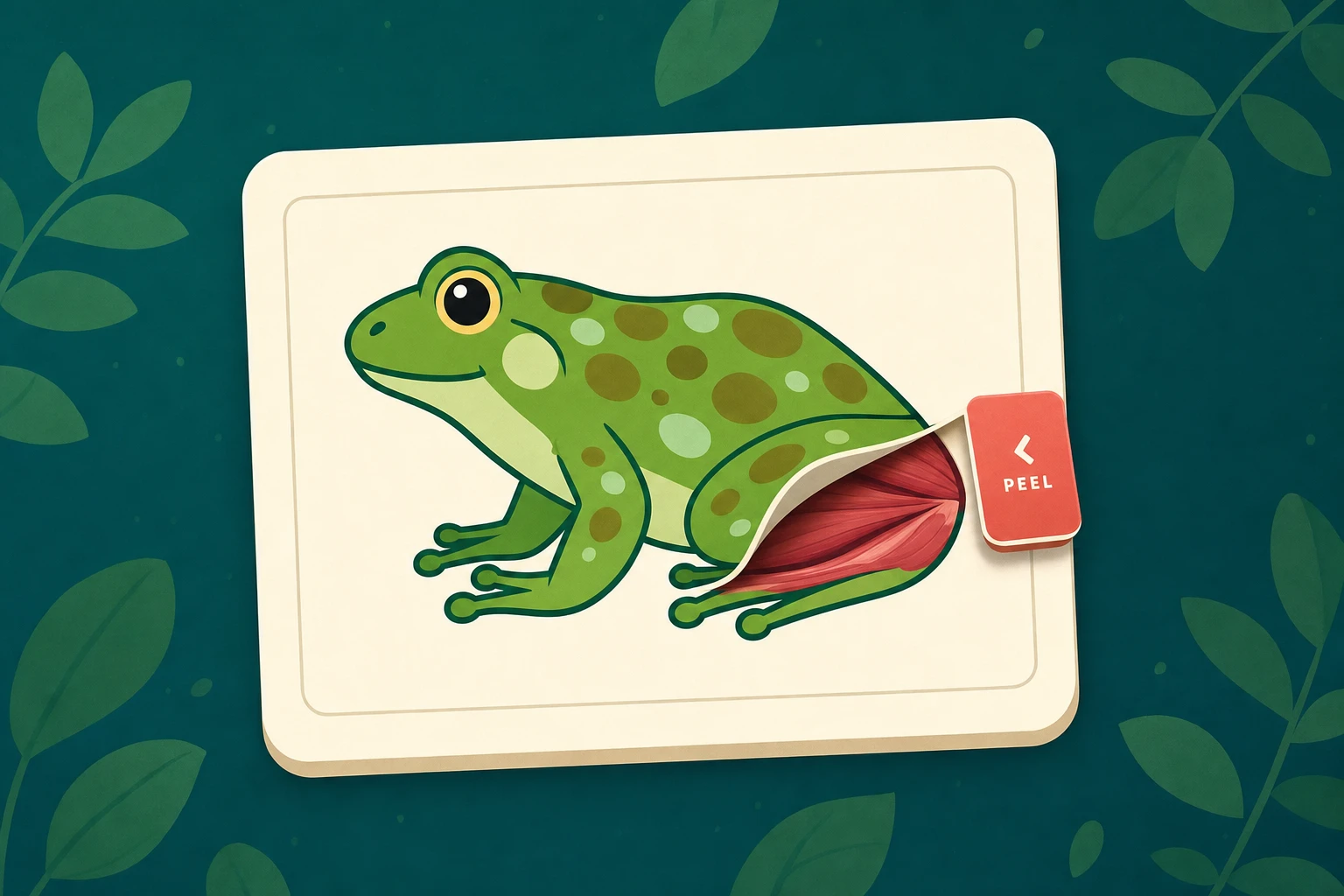 Body Explorer
Animal bodies contain fitted layers—skin, muscles, organs, and skeleton—that work together inside differently shaped animals.
Open lesson Circuit Rescue
Electric current flows only around one complete, unbroken loop; a switch controls that loop but is not the same as a broken wire, and every component in a series circuit shares the same route.
Open lesson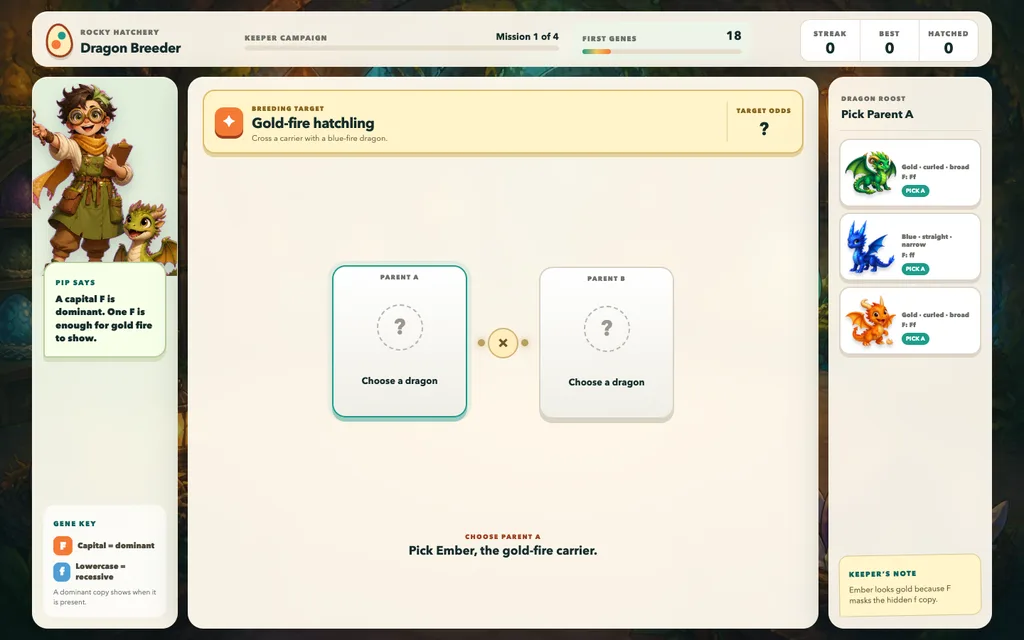 Dragon Breeder
An offspring receives one allele for each gene from each parent; dominant alleles can mask recessive alleles, and a Punnett square predicts probabilities rather than guaranteeing one outcome.
Open lesson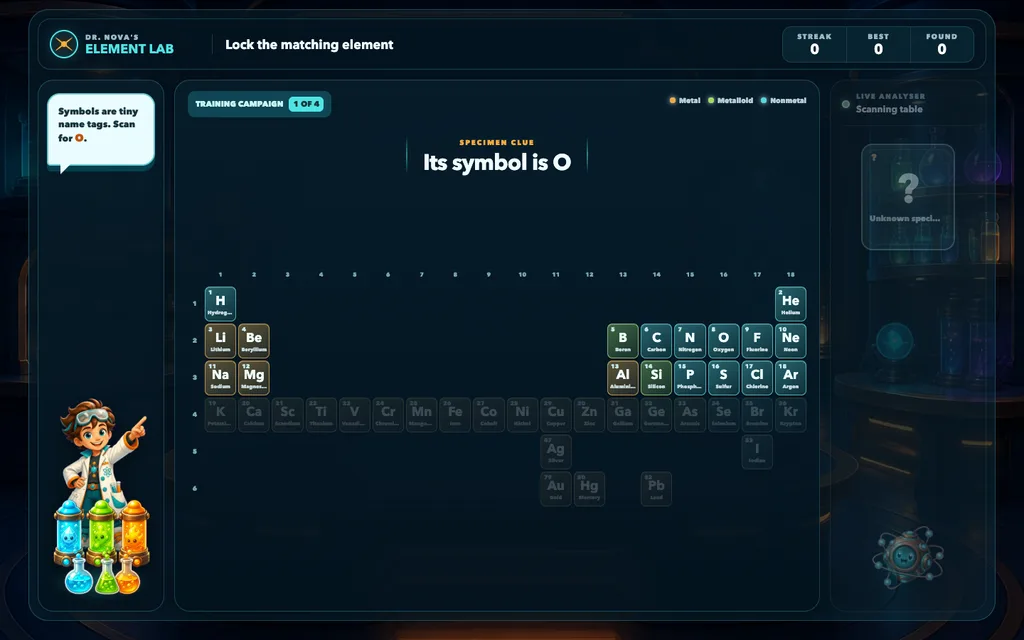 Element Lab
The periodic table is a map: atomic number identifies an element by its proton count, periods are rows, groups are columns with related properties, and symbols are short element names.
Open lesson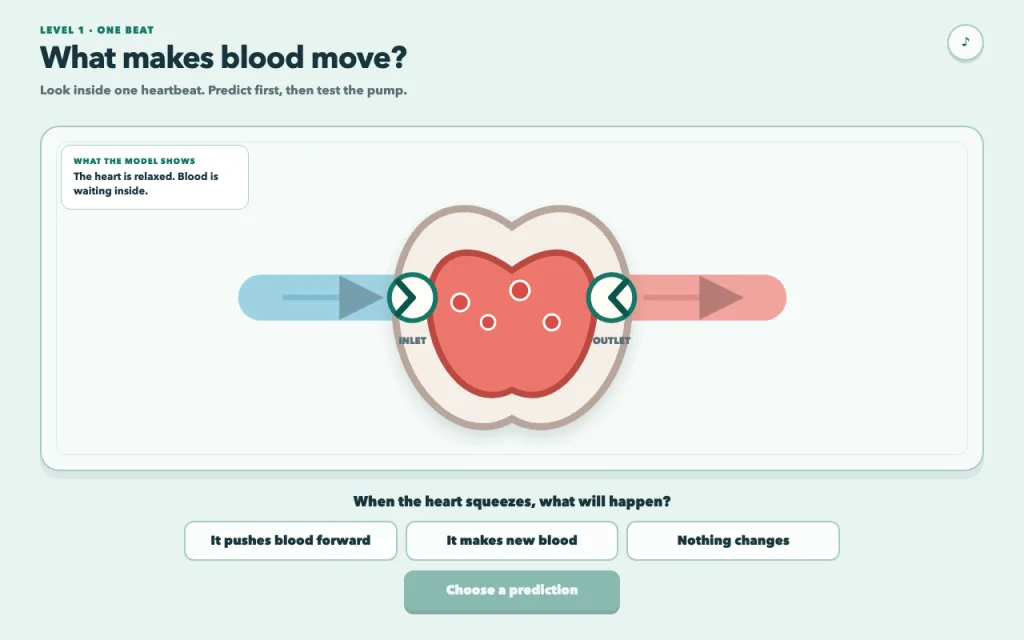 Heart Pump Lab
The heart is a pump: each muscle squeeze raises pressure, one-way valves direct that pressure into forward blood flow, and body demand changes how quickly the pump repeats.
Open lesson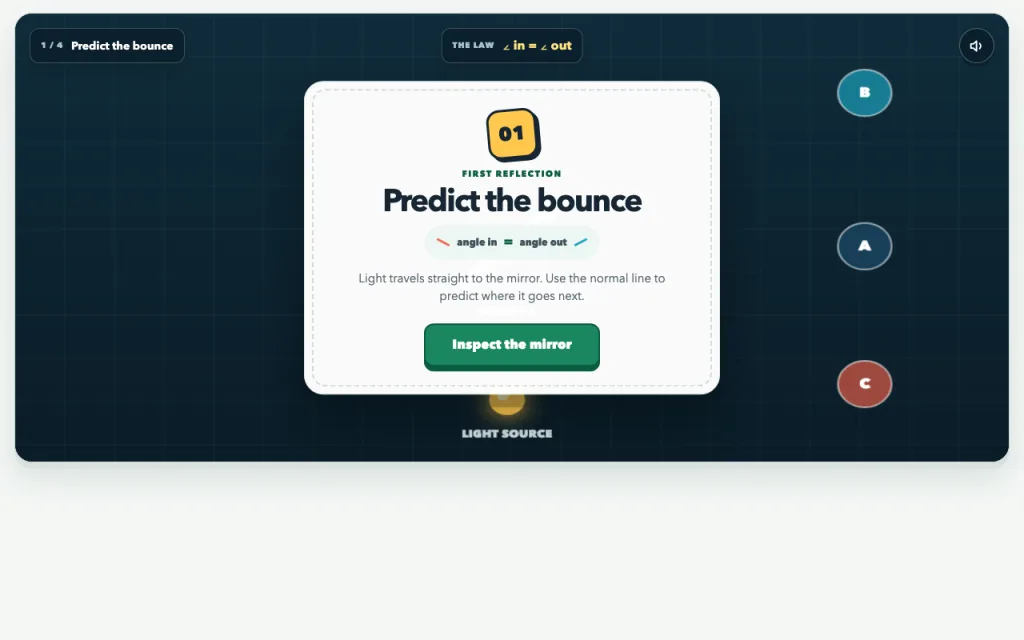 Light Reflection Maze
Light travels in straight lines and reflects from a mirror so its angle away from the normal equals its angle toward the normal.
Open lesson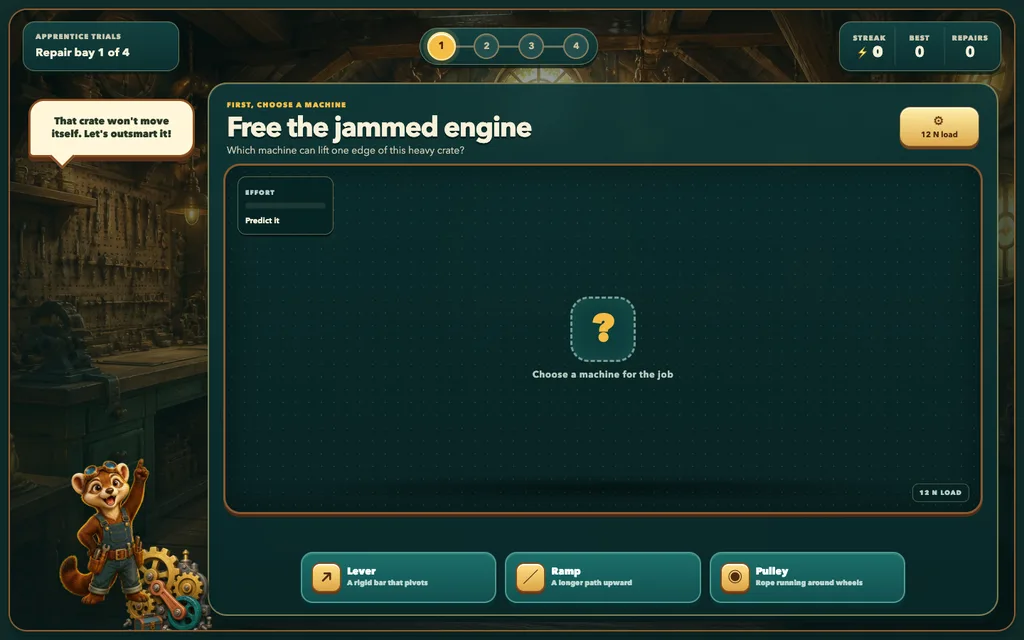 Moss & Cog Workshop
Simple machines make jobs easier by trading force for distance or changing the direction of a force; they do not remove the load's weight or create energy.
Open lesson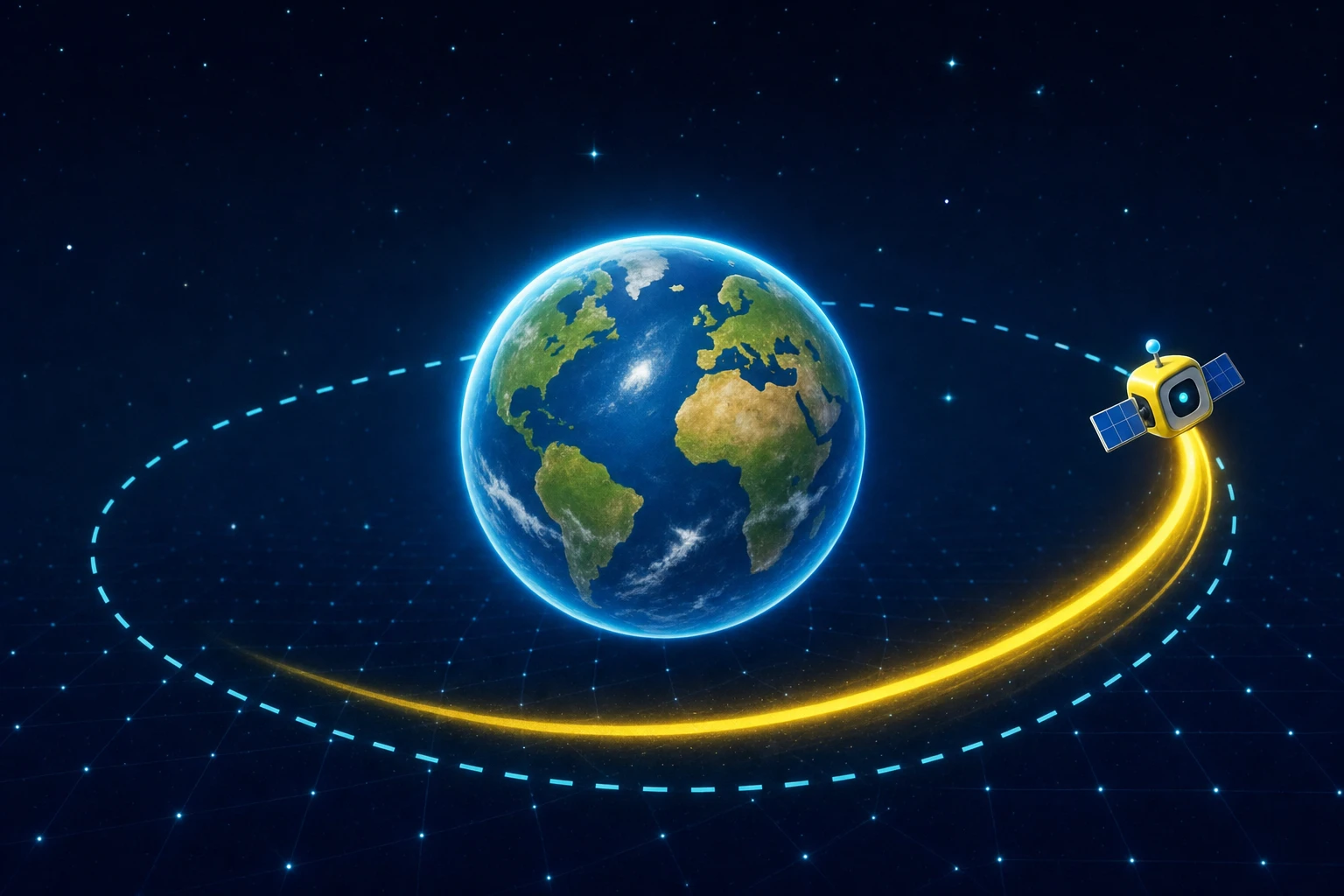 Orbit Lab
An orbit is constant falling: gravity bends sideways motion around a planet, while too little sideways speed crashes and too much escapes.
Open lesson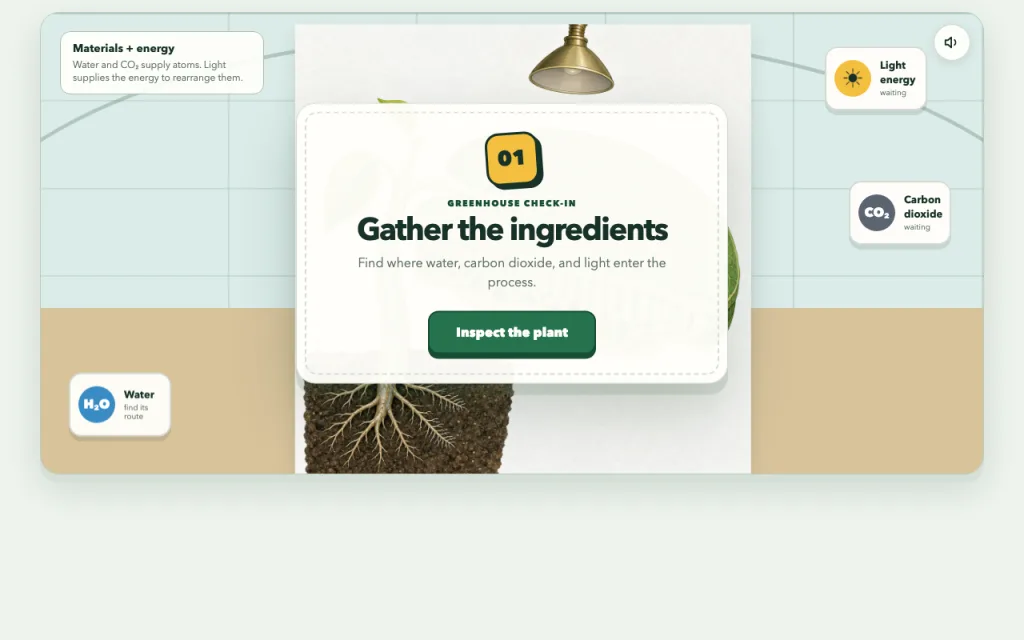 Photosynthesis Greenhouse
Plants use light energy to rearrange atoms from water and CO₂ into sugar and oxygen; atoms regroup rather than appearing, and the scarcest required input limits production.
Open lesson Plant PartsEach plant part has a distinct job, and roots, stems, leaves, flowers, and seeds work with sunlight, water, and air to help the whole plant live, grow, and begin a new generation.
Open lesson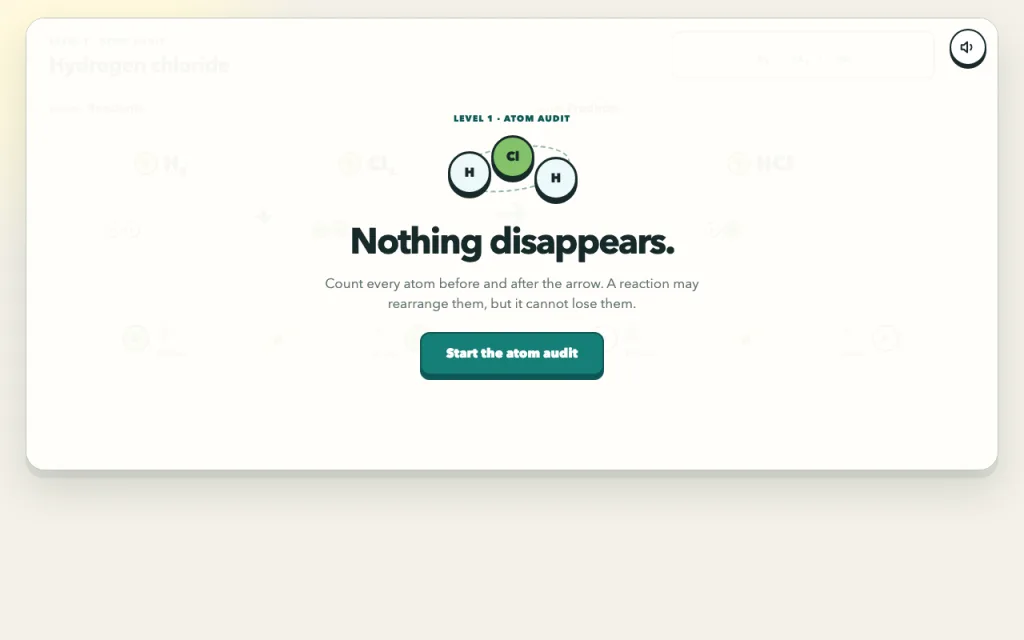 Reaction Balancer
A chemical reaction rearranges atoms but does not create or destroy them, so a correct equation has the same number of each kind of atom before and after the reaction.
Open lesson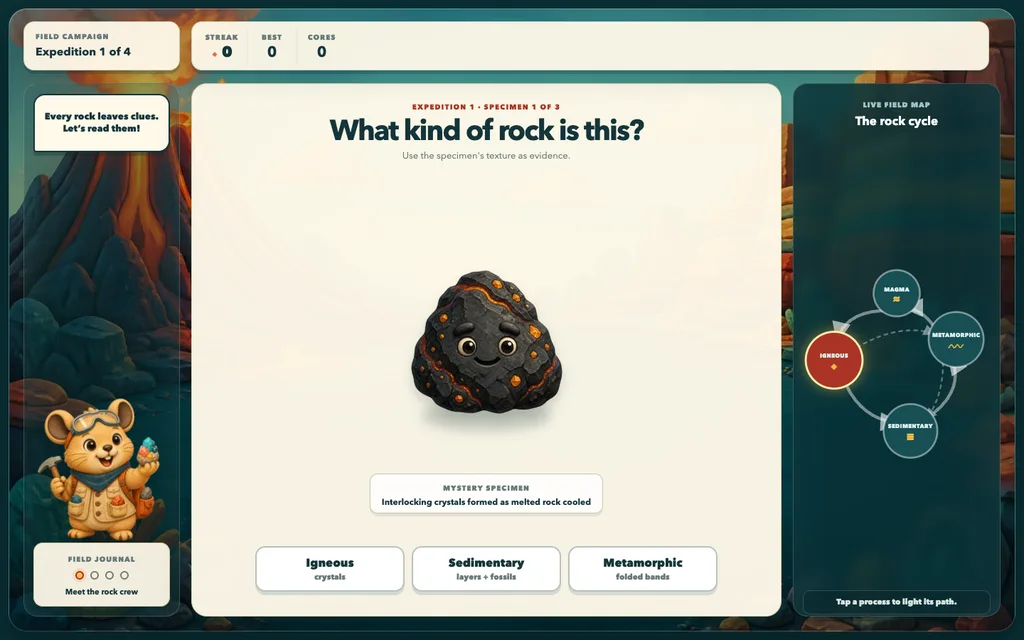 Rock Rover
Rock types are stages in a cycle: cooling makes igneous rock, surface weathering plus deposition and cementing makes sedimentary rock, heat and pressure make metamorphic rock, and melting returns rock to magma.
Open lesson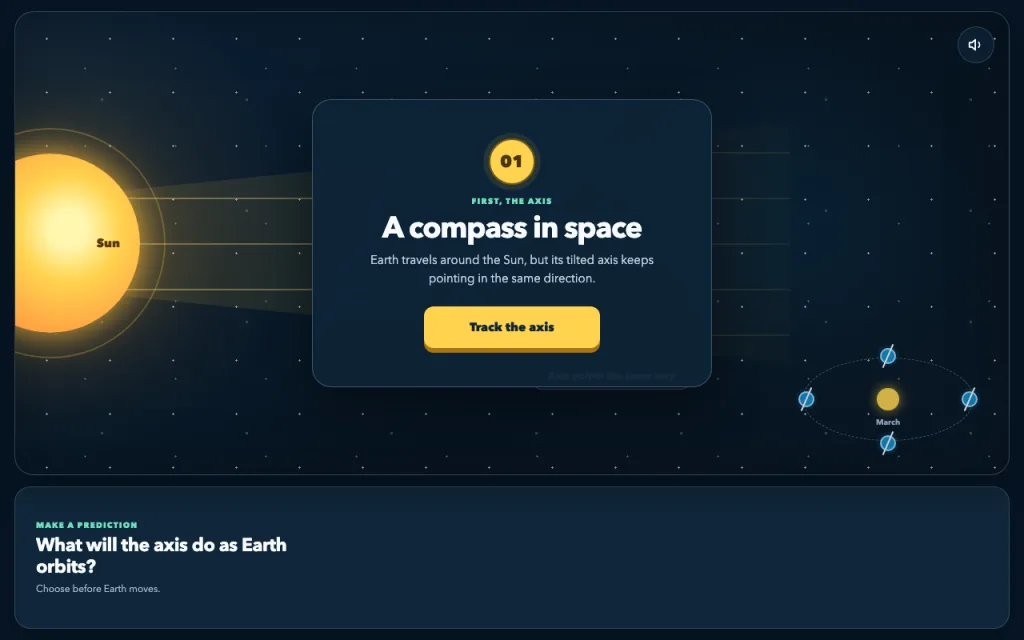 Seasons Globe
Earth's fixed axial tilt changes how directly sunlight hits each hemisphere: direct light is concentrated, while slanted light spreads the same energy over more area and heats less.
Open lesson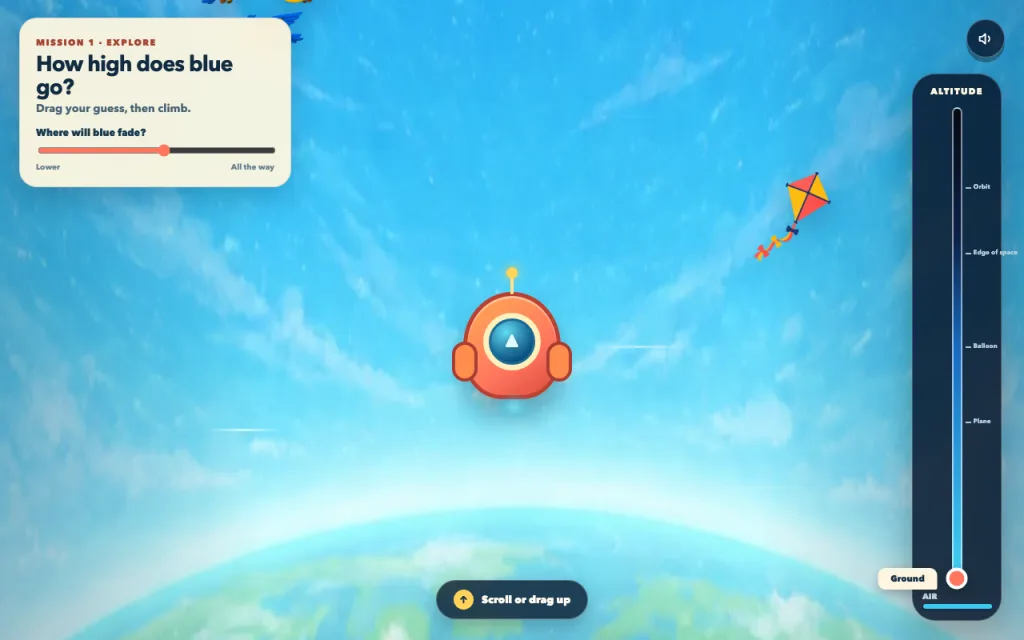 Sky High
As altitude increases, Earth’s air gets gradually thinner: birds and airplanes need enough air, balloons rise into thin air, and satellites orbit above almost all of it.
Open lesson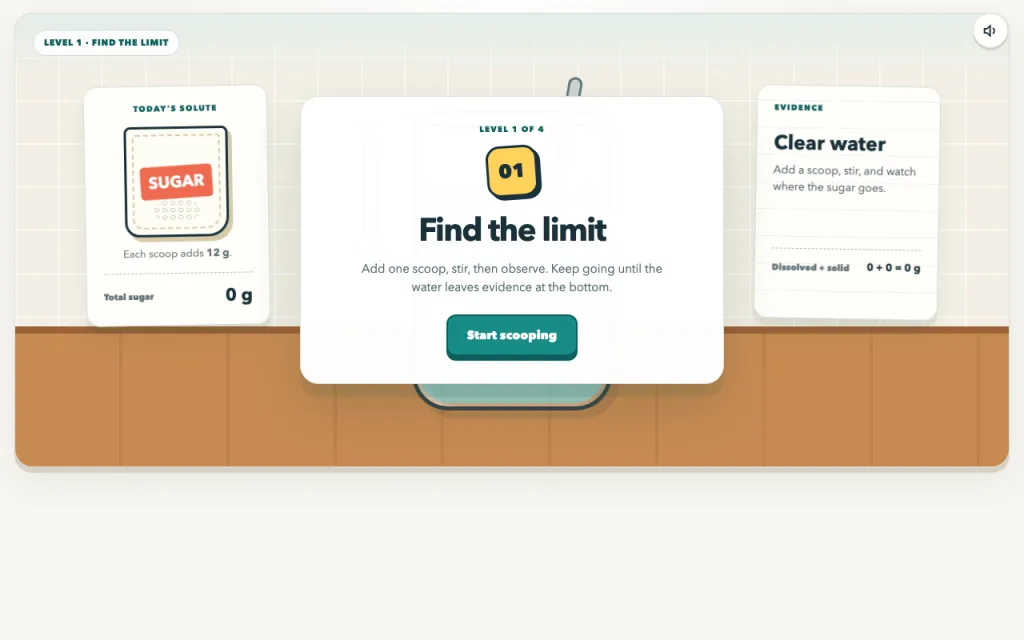 Solubility Kitchen
A liquid can dissolve only a limited amount of solute at a given temperature. Heating usually raises that limit, while cooling can make some dissolved solute become solid again.
Open lesson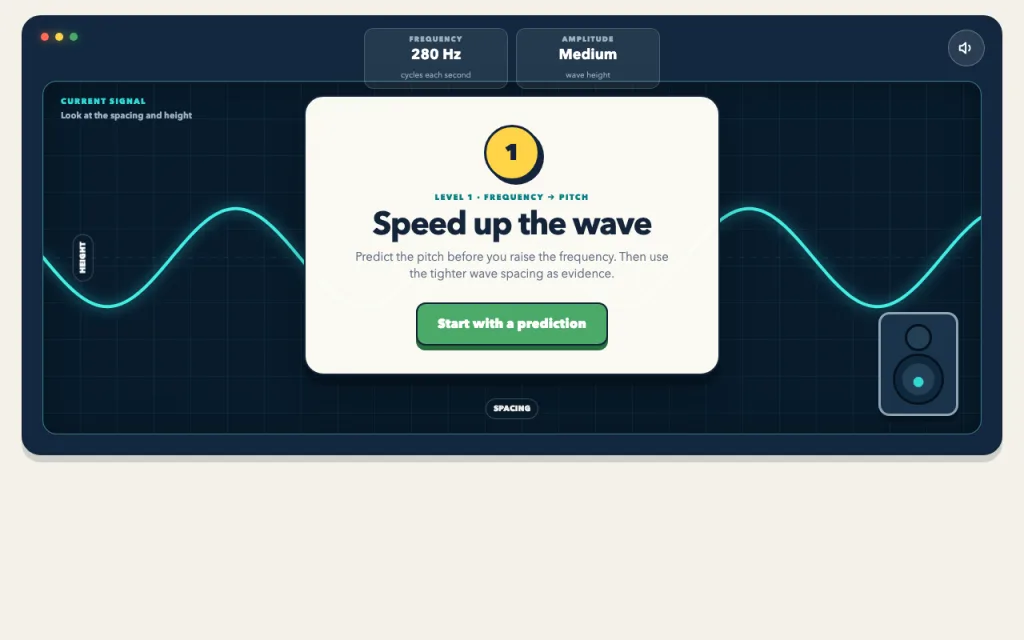 Sound Mixer
Frequency controls pitch and amplitude controls loudness; either one can change without changing the other.
Open lesson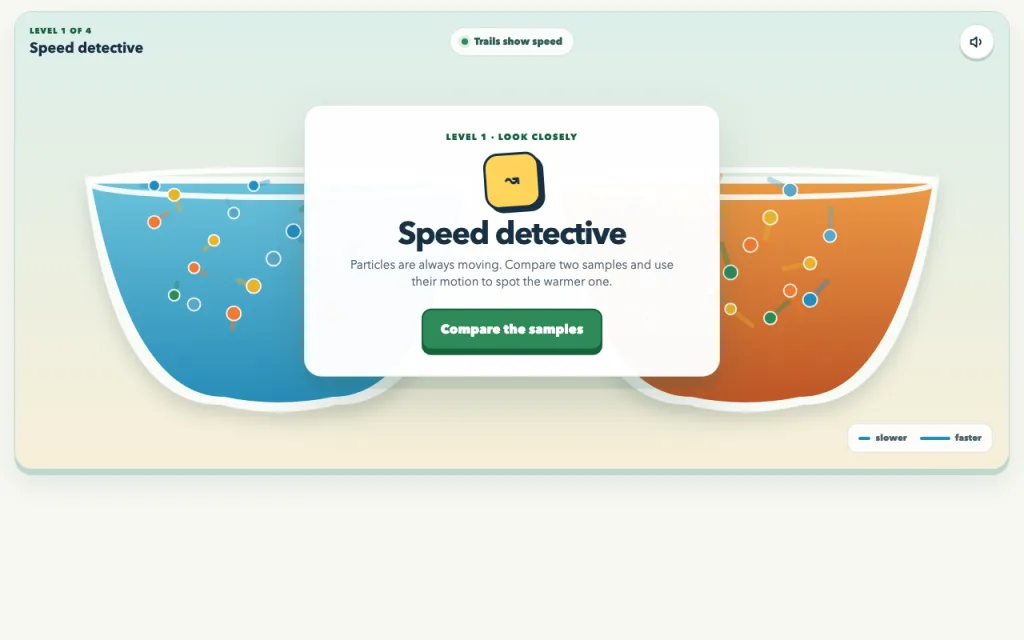 Soup Molecules
Heating gives particles more energy, so they move faster on average; the fastest particles at a liquid's surface can escape as vapor, which is evaporation and can cool the liquid left behind.
Open lesson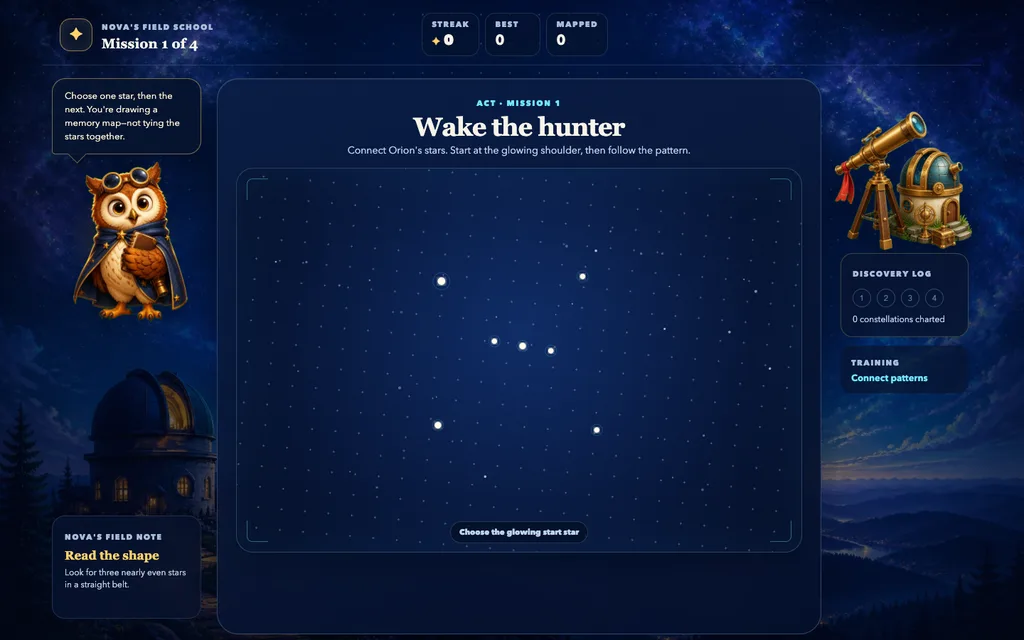 Star Mapper
Constellations are recognizable patterns we see from Earth: their stars are real, but the connecting lines are imaginary guides, and hemisphere and season change which patterns are easiest to find.
Open lesson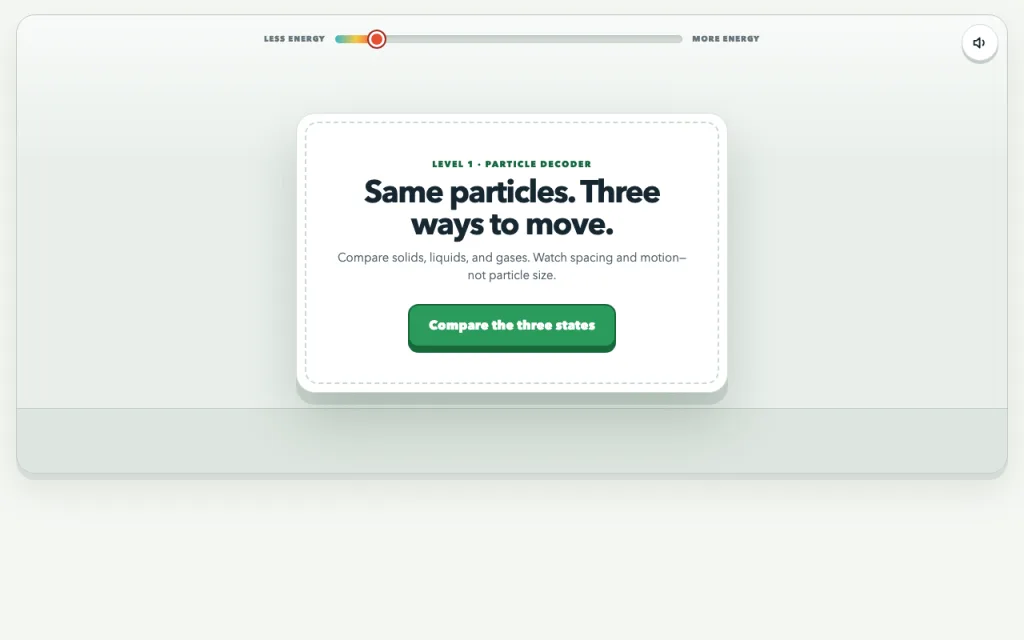 States of Matter Chamber
Solids, liquids, and gases contain the same-sized particles with different amounts of energy: heating makes particles move faster and more freely, while cooling makes them slow down and lock closer together.
Open lesson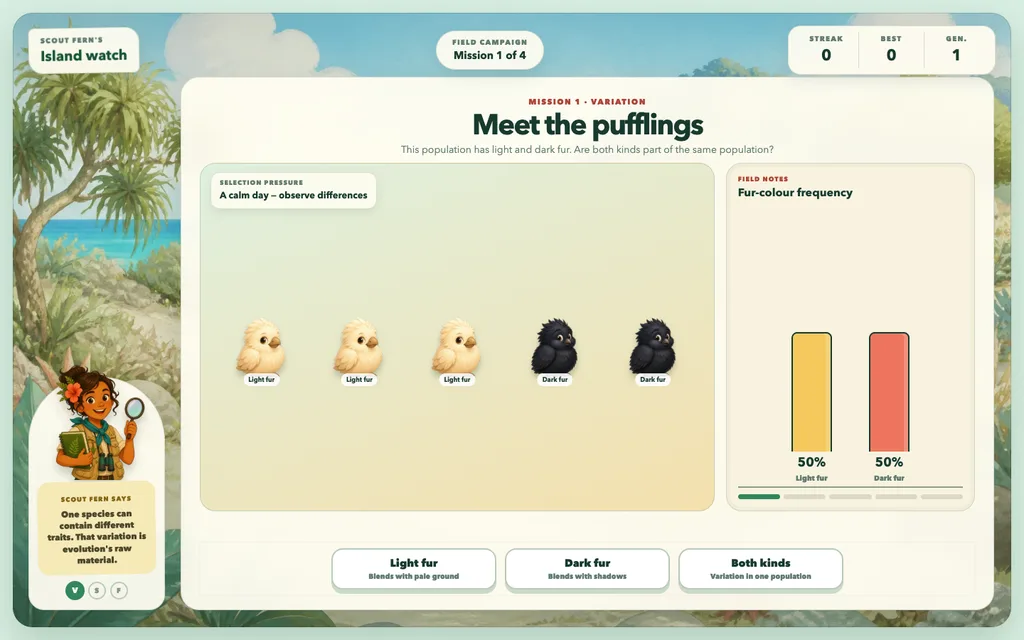 Survive the Island
Inherited traits vary within a population; when an environment lets better-suited individuals survive and reproduce more, those traits become more frequent over generations, so the population evolves.
Open lesson Tectonics
Tectonic plates keep moving, and pulling apart, pushing together, or sliding past creates predictable patterns of ridges, mountains, volcanoes, and earthquakes.
Open lesson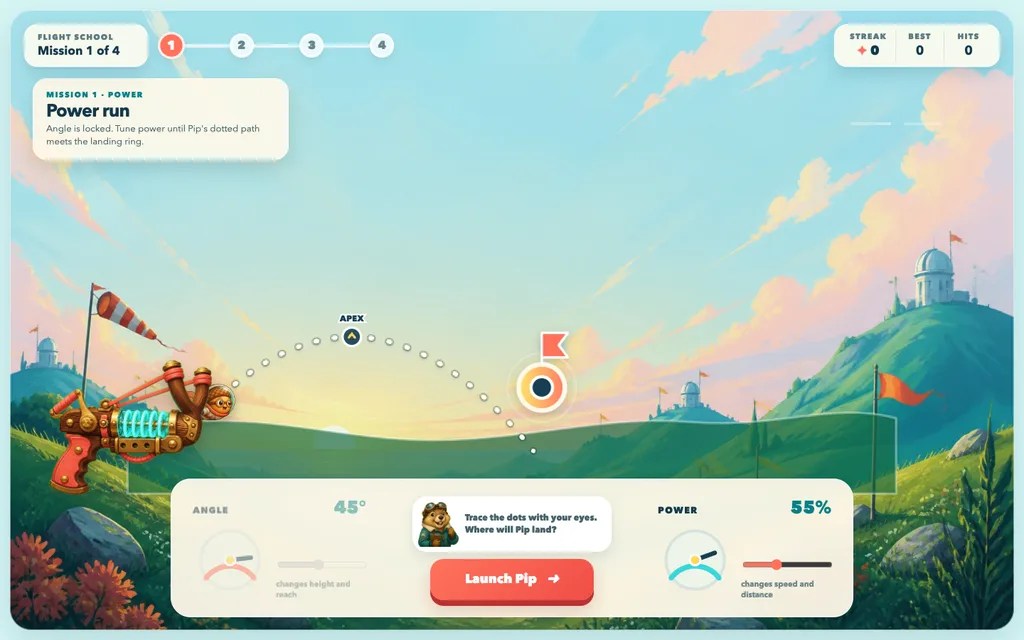 Trajectory Launch
A projectile's launch angle and power determine a predictable parabolic path; the apex and landing point can be read from that curve and represented by a quadratic equation.
Open lesson Weather WatchWeather clues such as clouds, temperature, wind, and repeating observations help us describe current conditions, prepare sensibly, and make simple forecasts that are predictions rather than promises.
Open lessonReading & English
Reading, spelling and grammar
 Alphabet Arcade
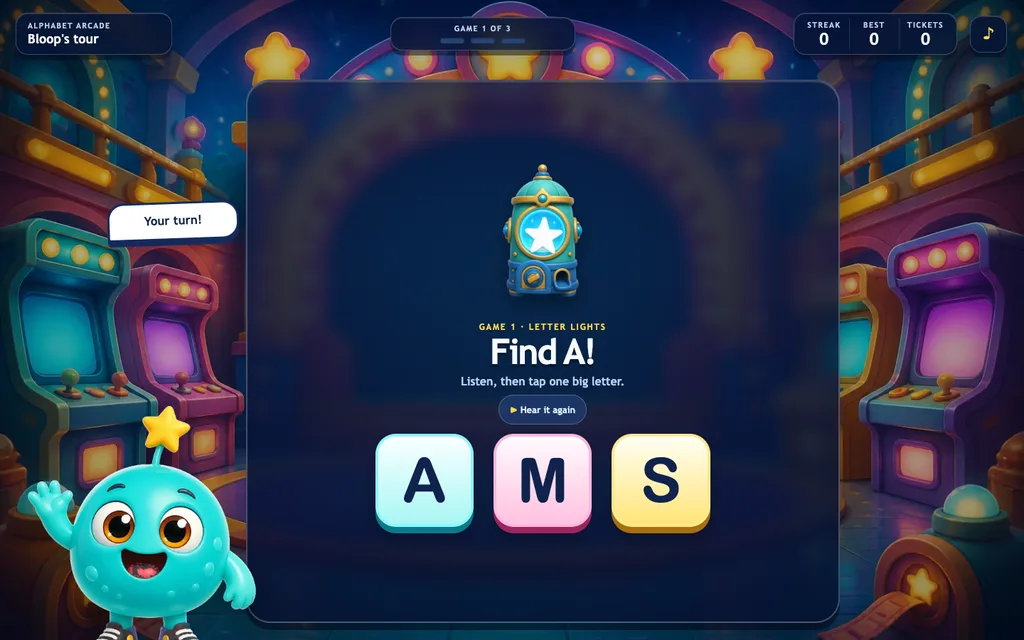
A letter keeps its identity when it is uppercase or lowercase, and its sound helps us recognize words that begin with it.
Open lesson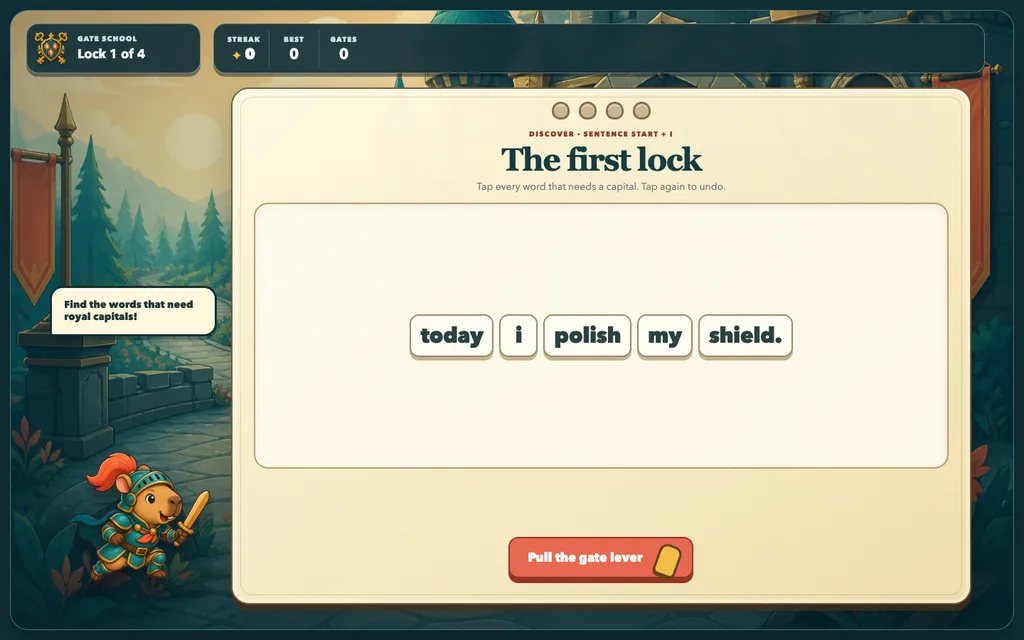 Capital Quest
Capital letters signal the beginning of a sentence and the special names of people, places, days, months, and titles; ordinary words stay lowercase.
Open lesson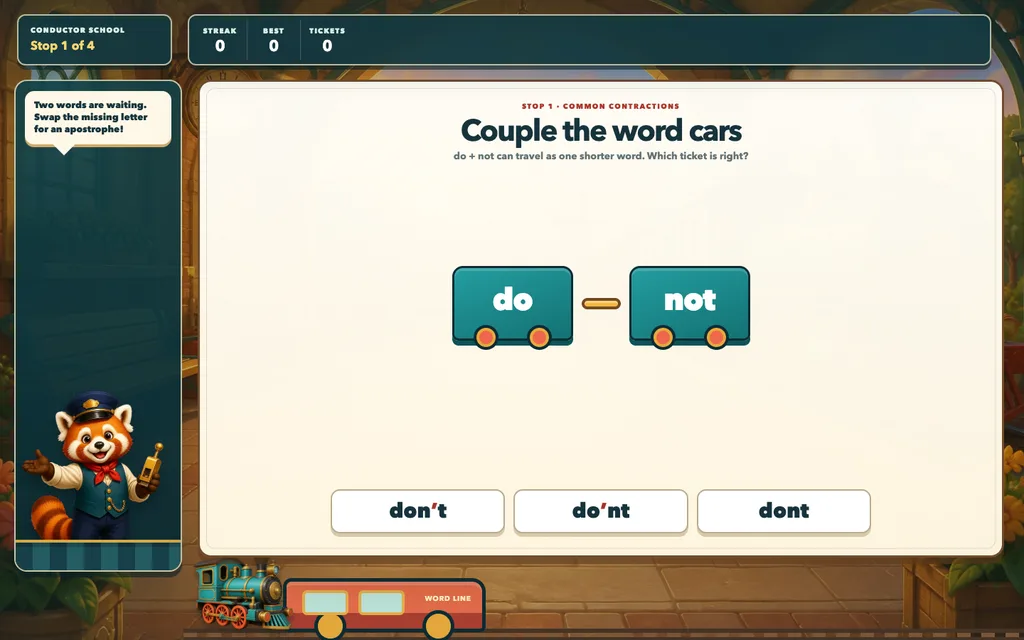 Contraction Station
A contraction joins words into a shorter form; the apostrophe stands where one or more letters were removed, while the meaning stays the same.
Open lesson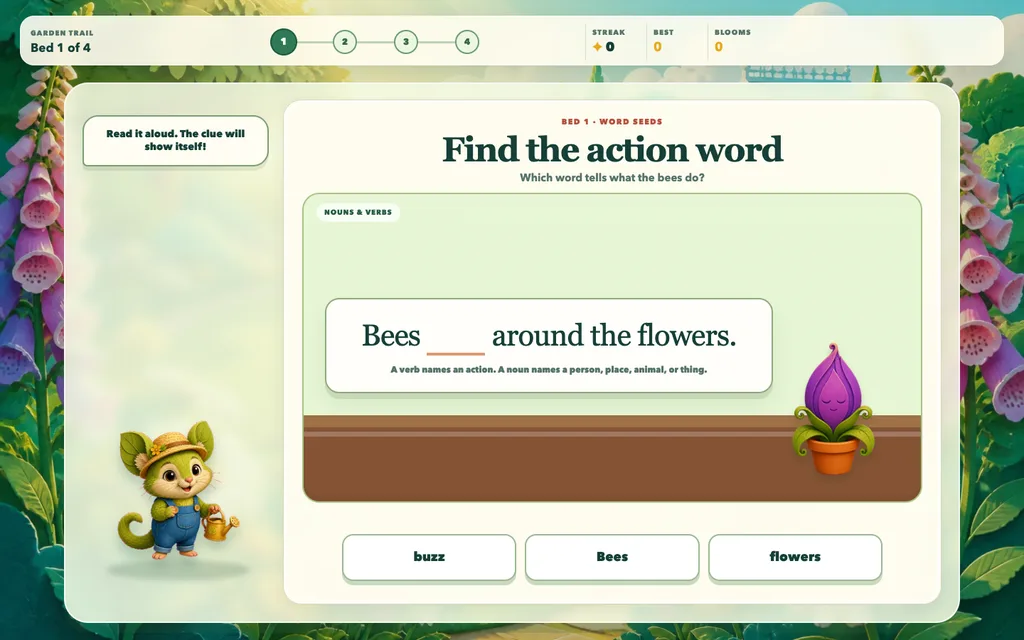 Grammar Garden
A sentence blooms when its words and marks agree with its meaning: the subject controls the verb, time controls the tense, and capitals and punctuation show where ideas begin and end.
Open lesson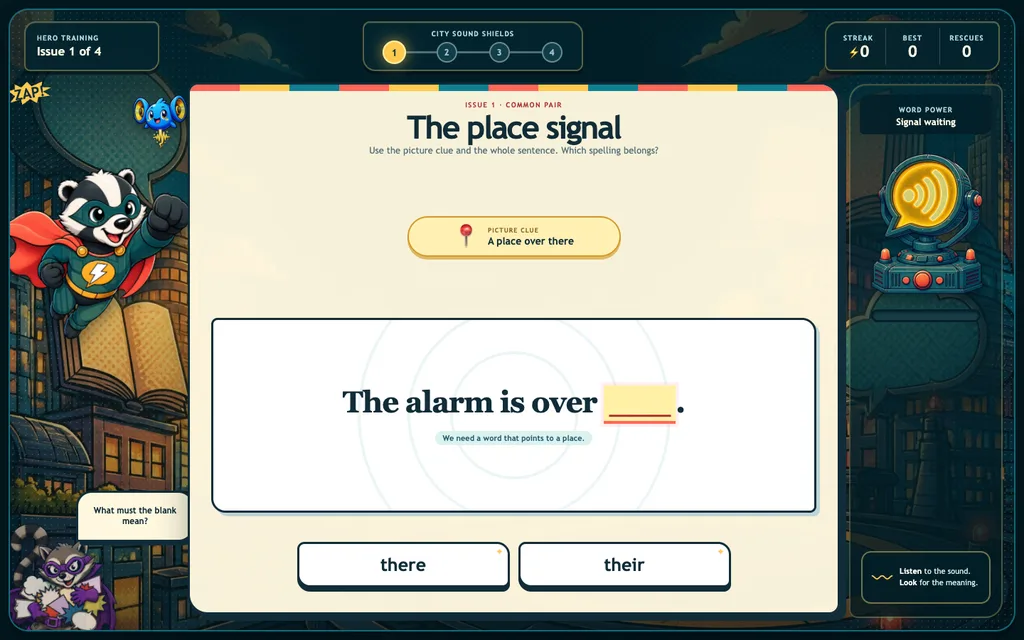 Homophone Heroes
Homophones sound alike but carry different meanings, so the surrounding sentence and picture clue—not the sound alone—reveal the word that belongs.
Open lesson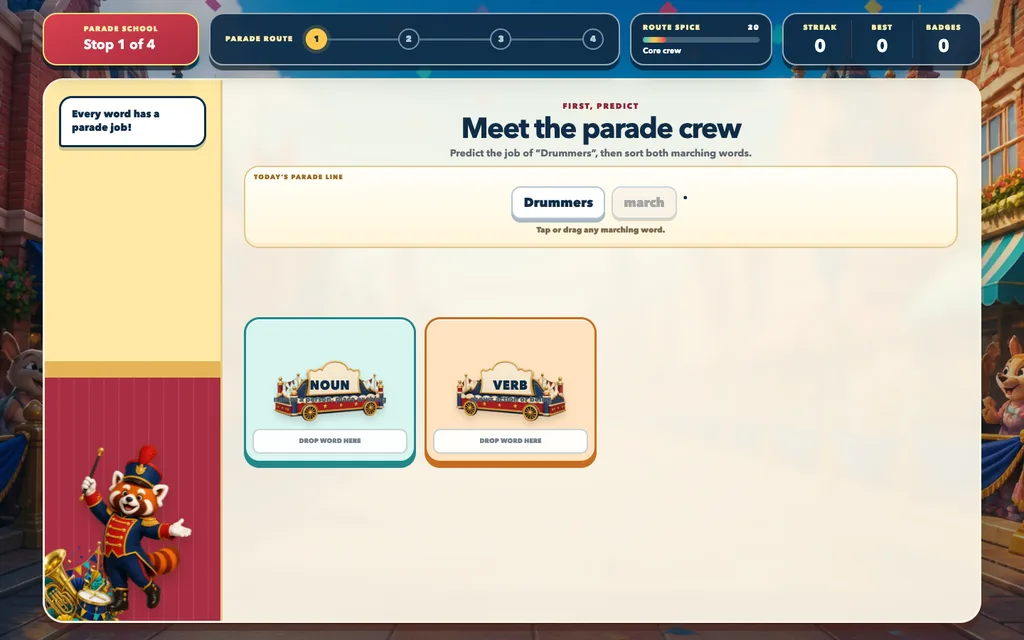 Parts of Speech Parade
A word's part of speech is the job it performs in its sentence: nouns name, verbs show action or being, adjectives describe nouns, and adverbs modify actions or descriptions.
Open lesson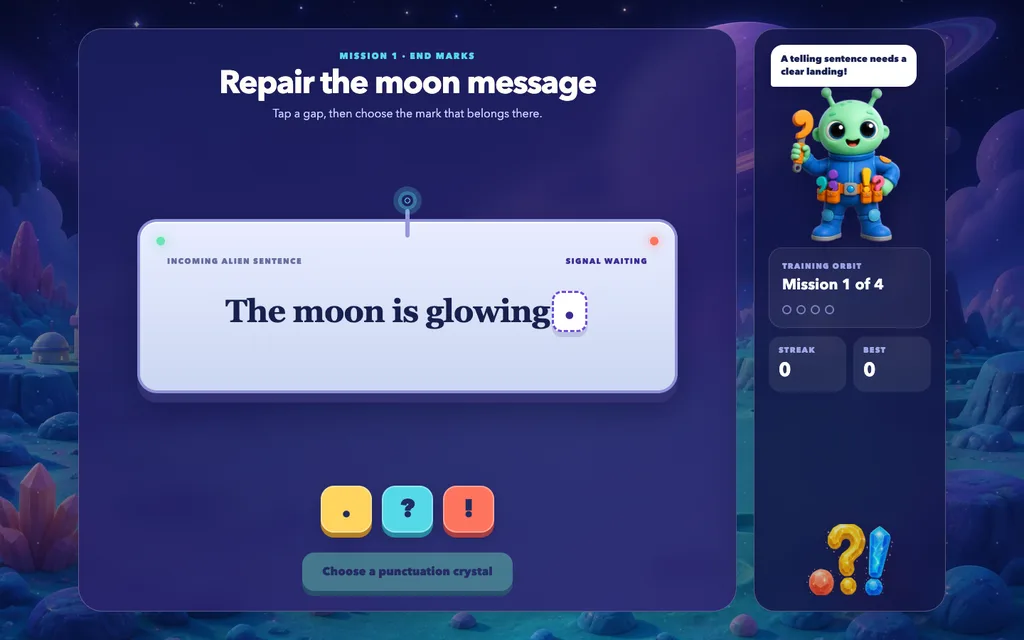 Punctuation Planet
Punctuation is part of a sentence's meaning: end marks show its intent, commas separate items, and apostrophes show missing letters or ownership.
Open lesson Sound BlenderA spoken word appears when every letter-sound or sound chunk is blended smoothly from left to right; the same ordered sounds can be segmented to build the written word.
Open lesson Trace & RaceClear handwriting grows from starting each stroke in the right place, moving in a steady direction, and following the strokes in order.
Open lesson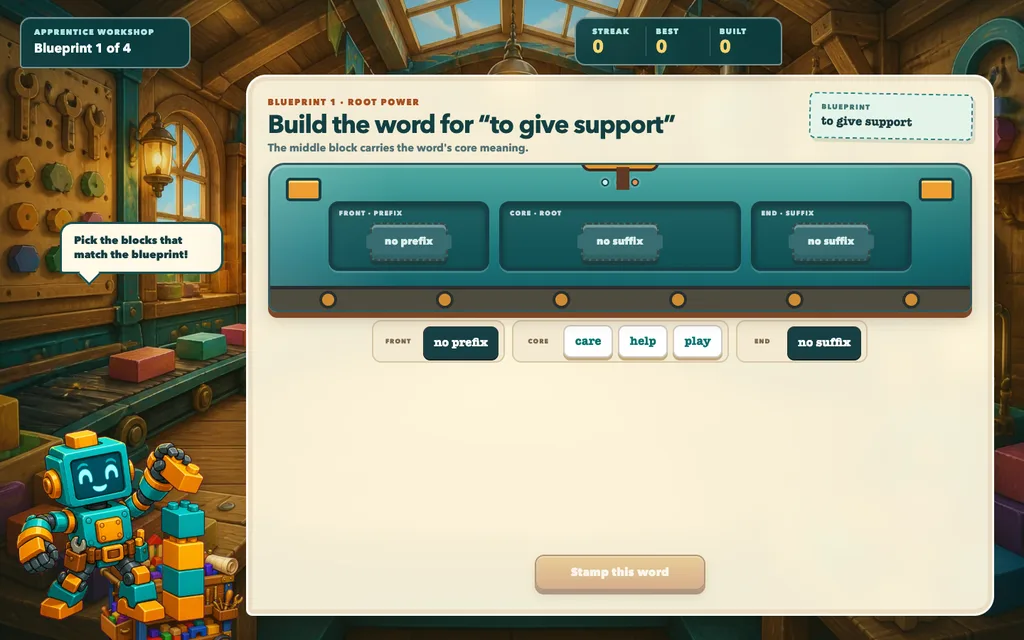 Word Builder
A root carries a word's core meaning; a prefix snaps onto the front and a suffix snaps onto the end to change or refine that meaning.
Open lesson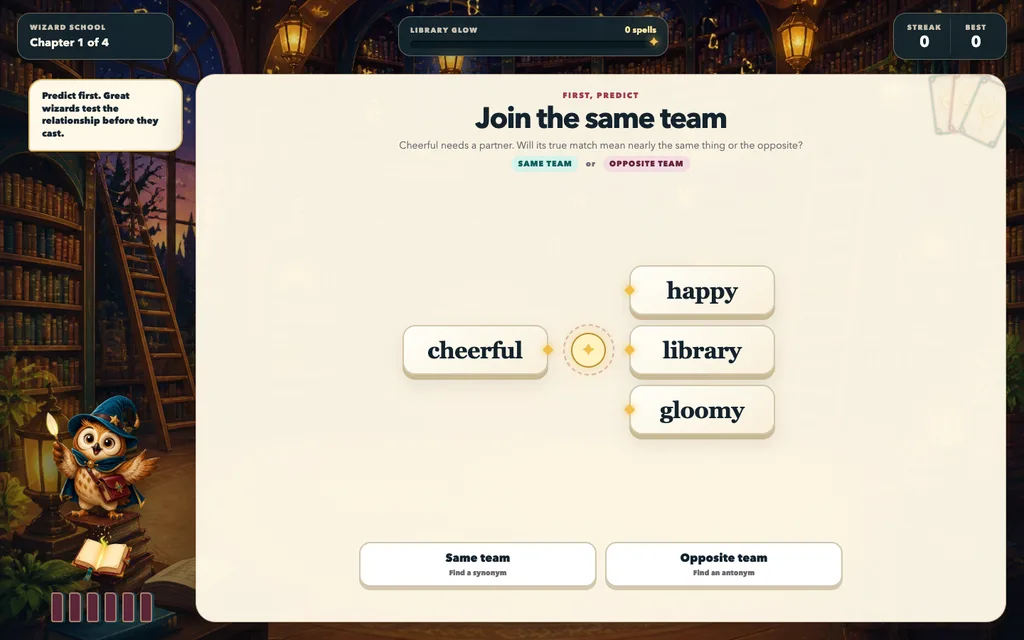 Word Match
Synonyms share a meaning team, antonyms pull meanings in opposite directions, and near-synonyms can carry different strengths or shades of meaning.
Open lesson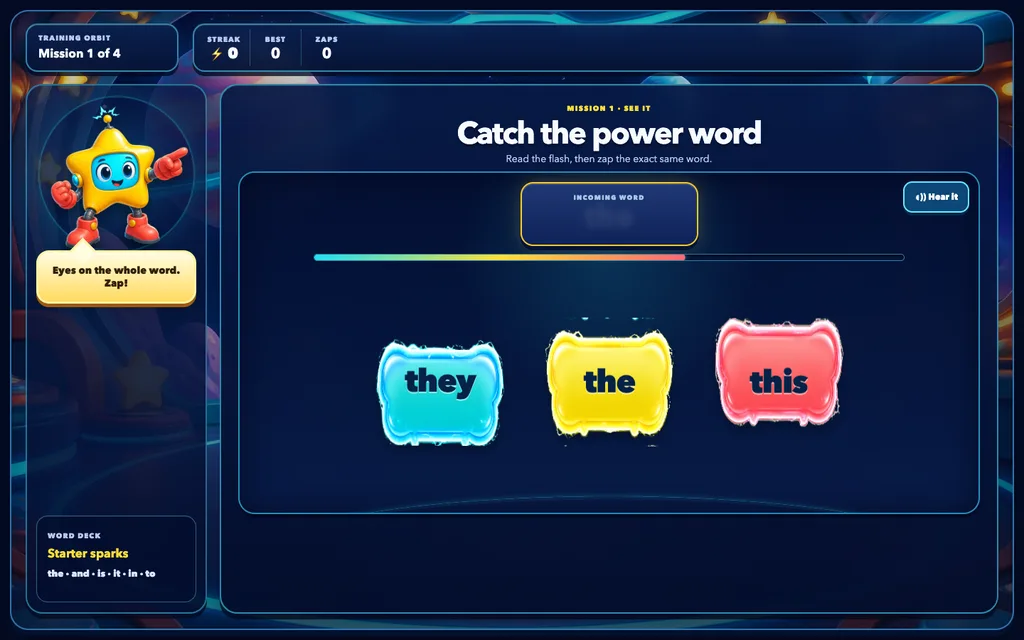 Word Zap
High-frequency words become quick to read when we recognise the whole written word, connect it to its spoken form, and practise it again after a useful gap.
Open lessonHistory
People, places and the past
Archaeologists use an artifact's material, symbols, shape, and purpose as evidence to connect it to the people and time that made it.
Open lesson Time Traveler's SuitcaseObjects are historical evidence: their materials, technology, and use help us place them in broad eras from the Stone Age to today.
Open lesson Timeline TowerA timeline orders events by when they happened: earlier events come before later events, and nearby dates help place events that are close together.
Open lessonGeography
Countries, maps and our world
Every U.S. state has one official capital city; grouping state-capital pairs by region and retrieving them in both directions makes all 50 easier to remember.
Open lesson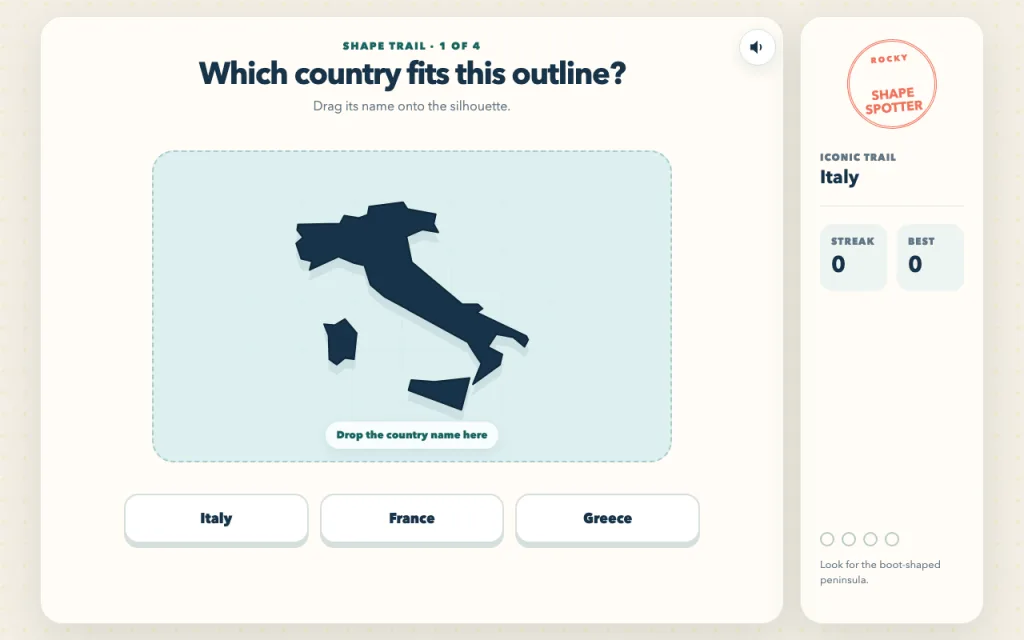 Country Shapes
Countries have distinctive outlines that can be recognised from coastline, borders, peninsulas, islands, and overall form rather than colour or map size.
Open lesson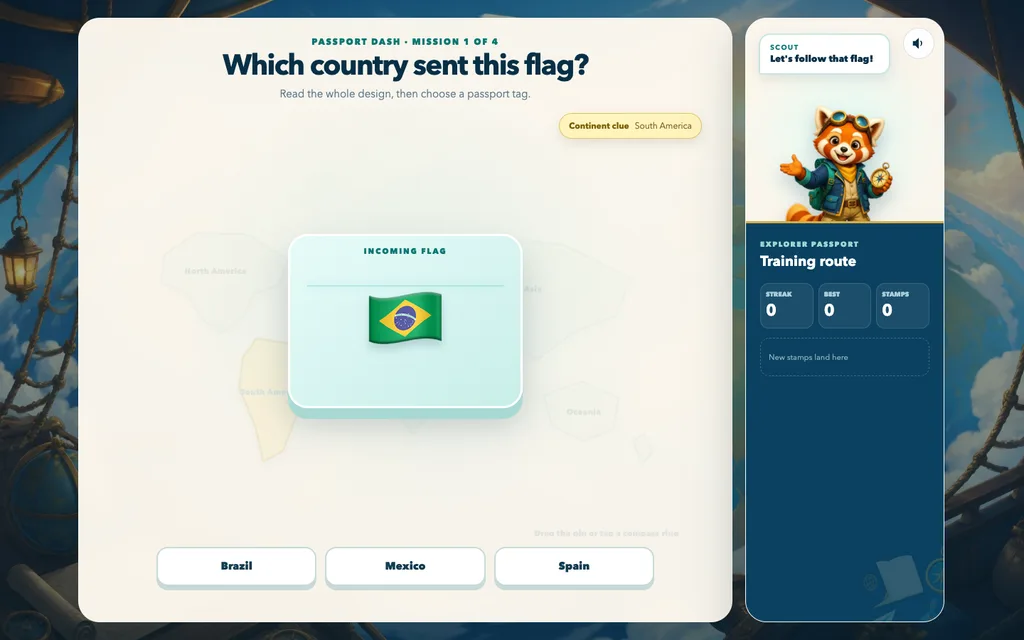 Flag Explorer
A flag identifies a country, and every country has a real location, capital, and story that can be connected on a world map.
Open lesson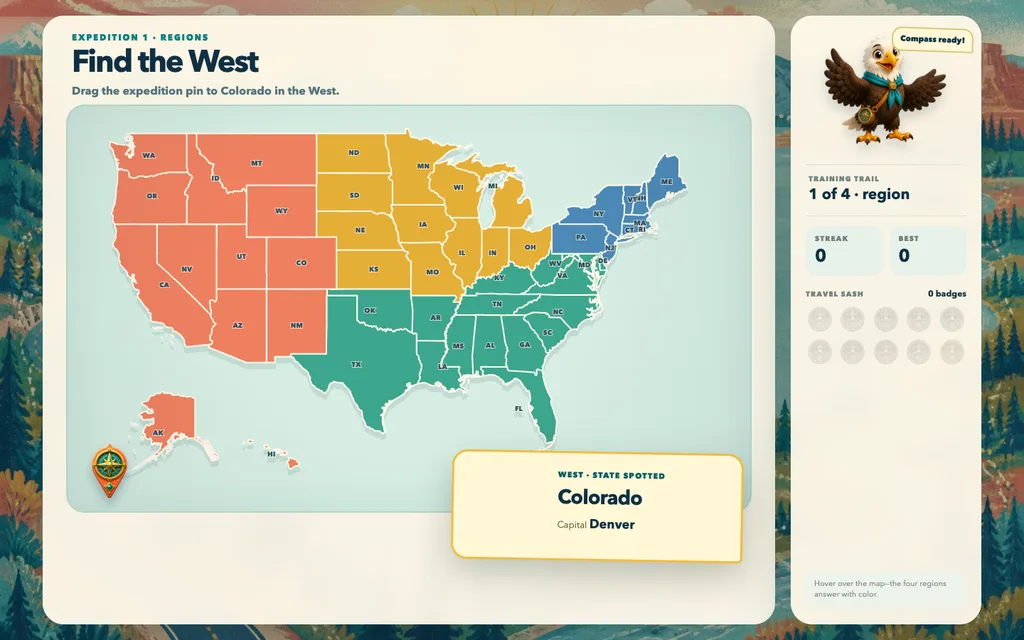 State Quest
Every U.S. state has a fixed location inside a larger region and one capital city; region anchors and neighboring shapes make both locations and capitals easier to retrieve.
Open lesson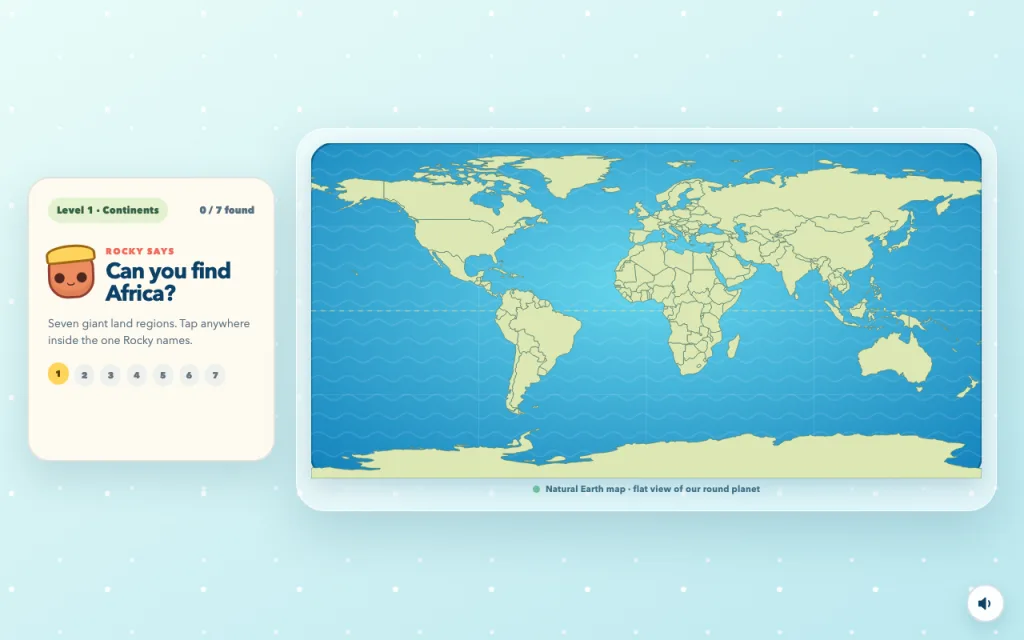 World Explorer
The round world can be shown on a flat map: continents are large land regions, countries are smaller areas within them, and oceans flow between them in consistent locations.
Open lessonArt, design & music
Drawing, design and music
 Design Lab
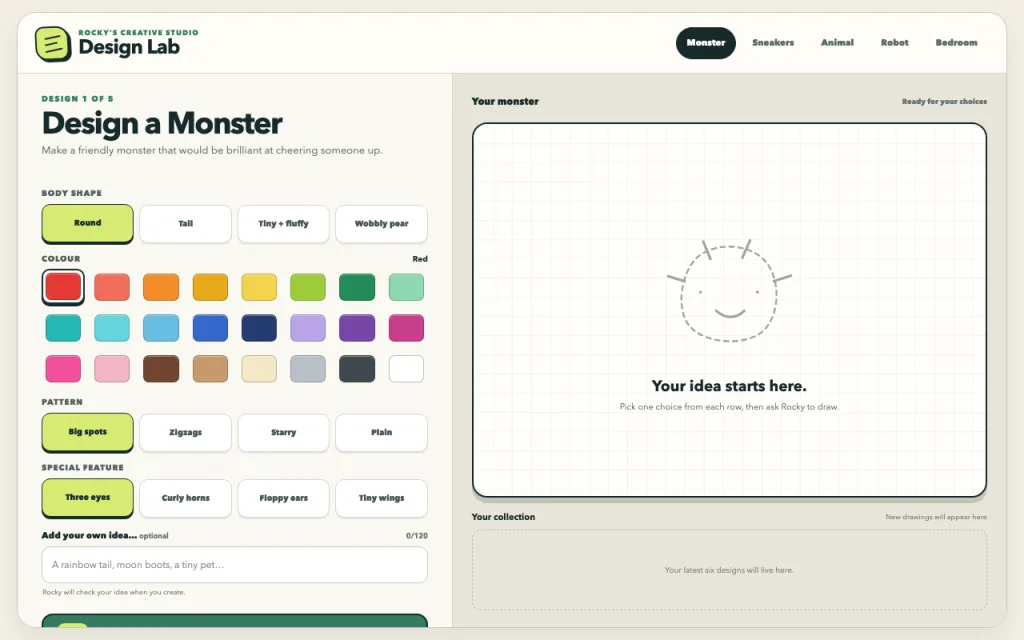
Design is a series of choices that work together to express an idea.
Open lesson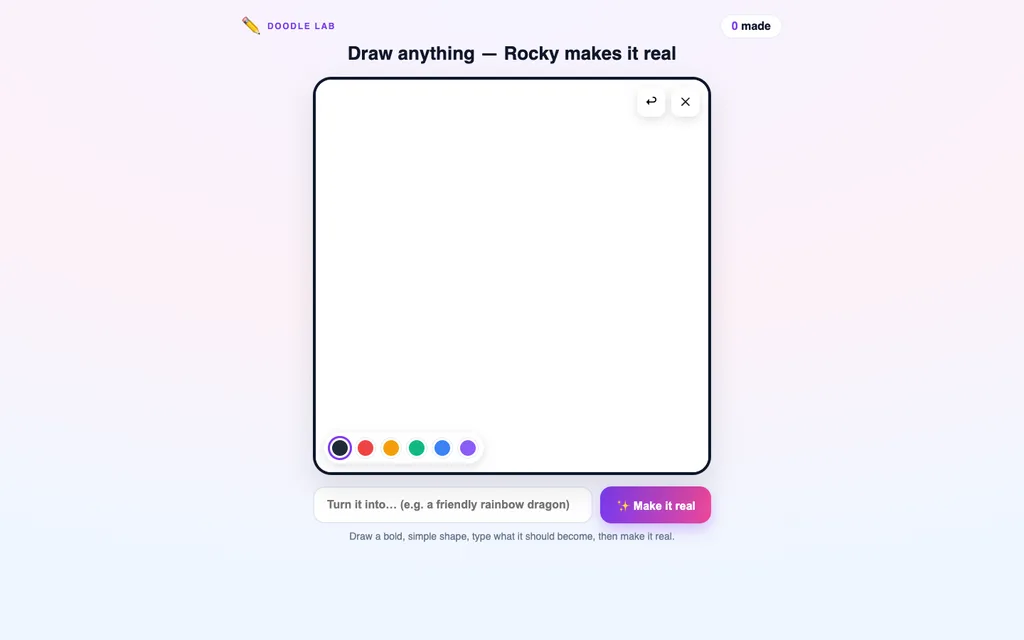 Doodle Lab
A rough sketch carries an idea; describing what it should become brings it to life.
Open lesson Note NestOn a treble-clef staff, each higher line or space moves to the next letter name, while the note head tells how many beats the pitch lasts.
Open lessonDigital technology
Coding, digital systems and logic
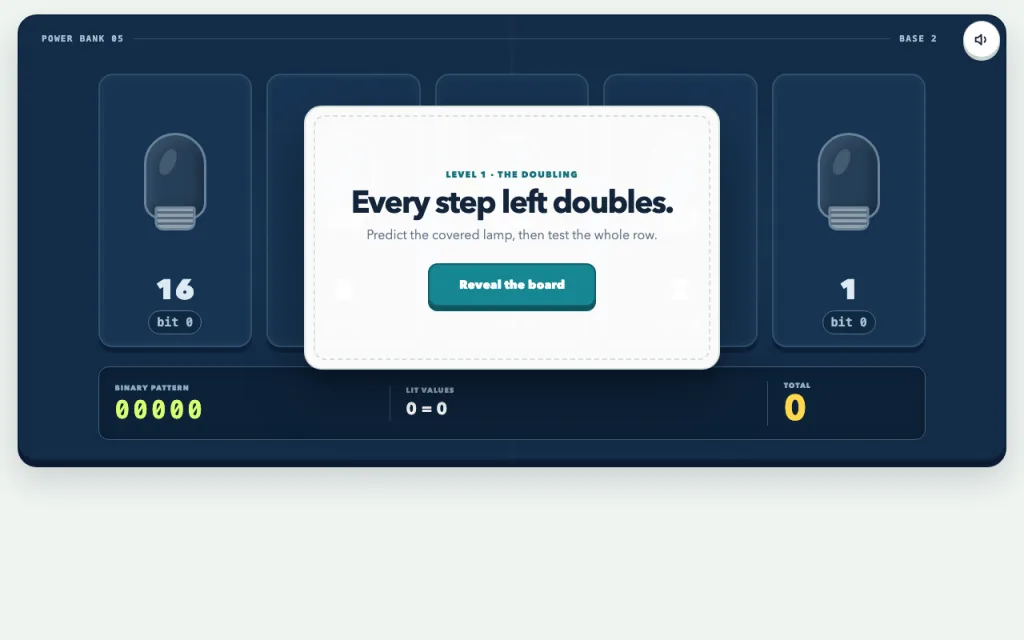 Binary Lights
A binary bit switches one fixed power of two on or off; each place doubles to the left, so every whole number has one unique binary pattern.
Open lesson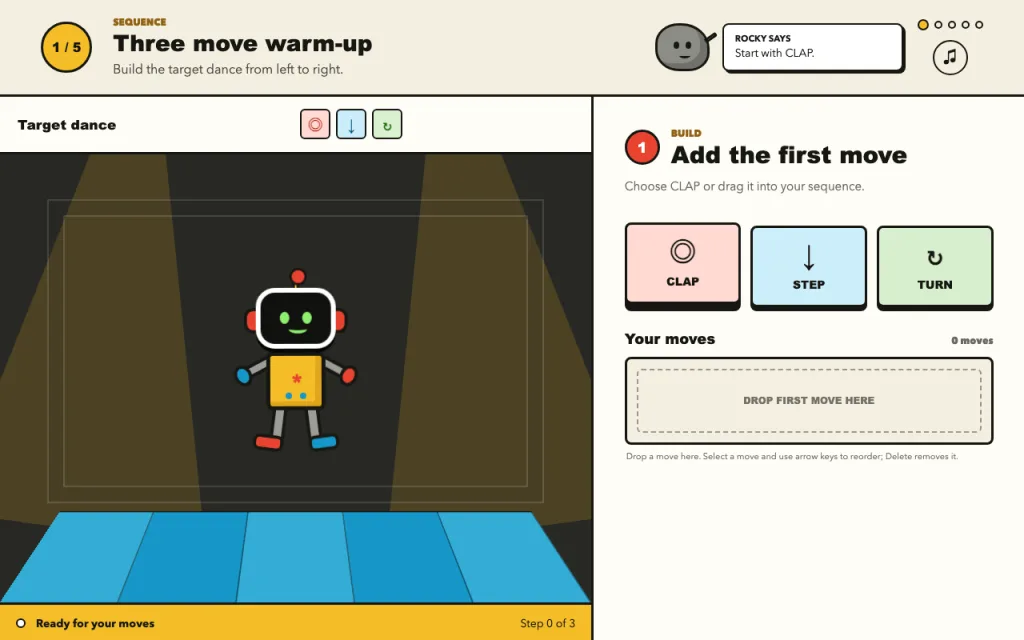 Loop Dance
A loop repeats instructions — you can say more with less, and the loop count times the body length tells you exactly what will happen.
Open lesson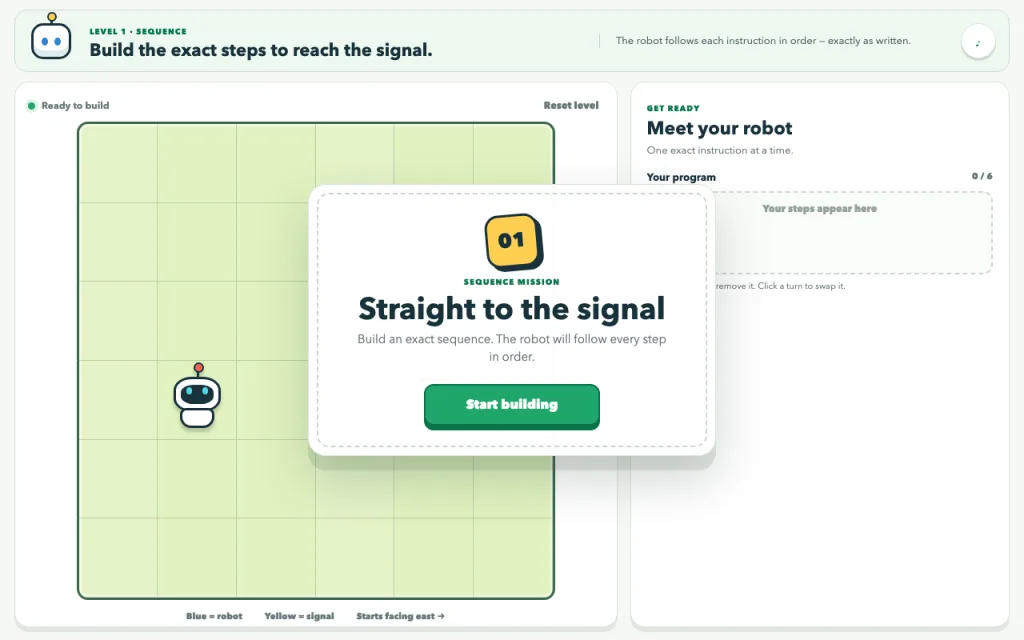 Robot Instructions
A program is an exact sequence of instructions: a robot follows precisely what each instruction says, in order, so changing the order or a turn changes the result.
Open lesson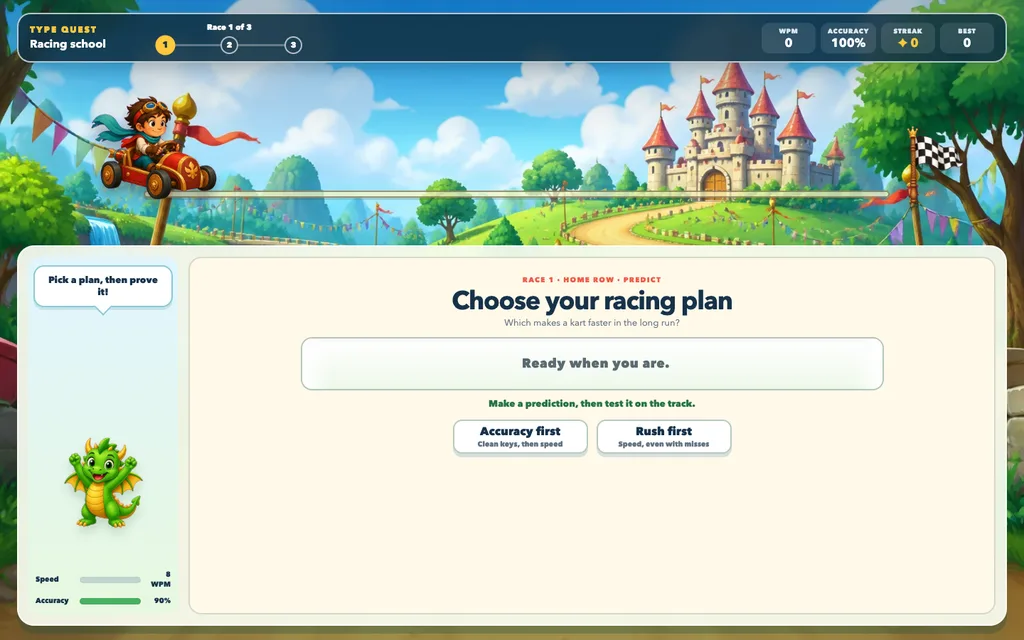 Type Quest
Accurate touch-typing builds a smooth, repeatable rhythm; once accuracy holds, speed can rise without losing control.
Open lessonMore to explore
Curious topics that cross subjects
Greetings and farewells fit a visible social context: time, formality, arrival, and whether the speaker or listener is leaving.
Open lesson Te Tinana — Body PartsBody-part kupu connect to locations and movements when a learner builds a sequence and watches each written word cause the matching body touch.
Open lesson