Estimation Station
A useful estimate is a nearby, quick answer made with groups, familiar benchmarks, or rounded numbers; comparing it with the actual result helps us judge whether an answer is reasonable.
What your child will figure out
- Estimate a visible quantity by grouping rather than counting every item.
- Estimate a length by comparing it with a visible benchmark.
- Round two or three addends to friendly tens or hundreds and combine them to estimate a sum.
- Use an estimate to reject unreasonable claimed totals across repeated transfer challenges, then refine accuracy through adaptive practice.
The levels
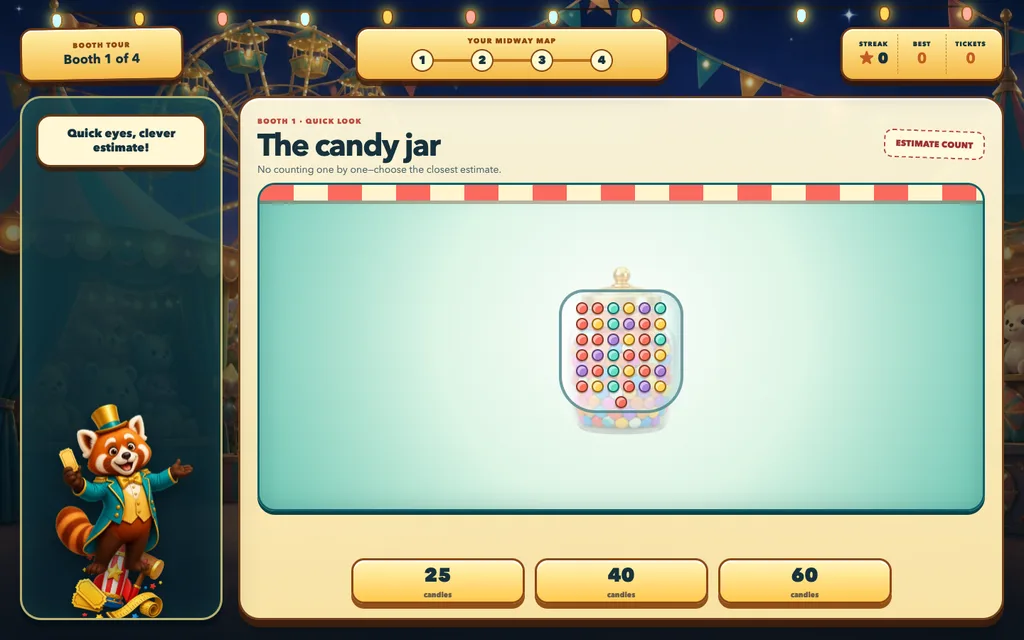
- The candy jar
Predict about how many candies are visible, reveal 37, and explain how groups of about ten support 40.
- Rocket ribbon
Estimate a prize rocket against a ruler benchmark, reveal 68 cm, and explain why 70 cm is sensible.
- Ticket total
Round 48 and 73 to friendly tens, estimate 120, reveal 121, and explain the round-then-add strategy.
- Button barrel
Build an estimate of 86 from visible groups and distinguish a supported estimate from counting or guessing.
- Banner stretch
Estimate 143 cm by coordinating 100 cm and nearby ten-centimetre benchmarks.
- Two prize counters
Round 126 and 278 to tens and combine 130 + 280 to estimate 410.
- The impossible jackpot
Transfer estimation to a reasonableness check and reject the claim that 198 + 304 is about 900.
- Packed token drum
Estimate 146 with tighter choices by using rows, chunks, and gaps rather than one-by-one counting.
- Pennant line
Estimate 92 cm with close choices by adjusting down from a 100 cm benchmark.
- Hundreds headliner
Round 347 and 582 to hundreds and use 300 + 600 to estimate 900.
- Double-or-nothing sign
Use 600 + 400 to reject the claim that 612 + 389 is about 1,600.
- Grand midway total
Transfer rounding to three addends by estimating 249 + 451 + 318 as 1,000.
Ready when they are.
Play Estimation Station free — no account, no card.
Play Estimation Station free