Prime Detective
A prime number has exactly two factors, 1 and itself; a composite number has additional factor pairs, which can be found by testing divisors only up to its square root.
What your child will figure out
- Test whether a number has an exact factor and use the product as visible evidence.
- Classify primes, composites, perfect squares, and semiprimes from complete factor evidence rather than appearance.
- Build every factor pair without duplicates and test unfamiliar numbers efficiently by stopping at the square root.
- Use a sieve to remove multiples and reveal the primes that remain.
The levels
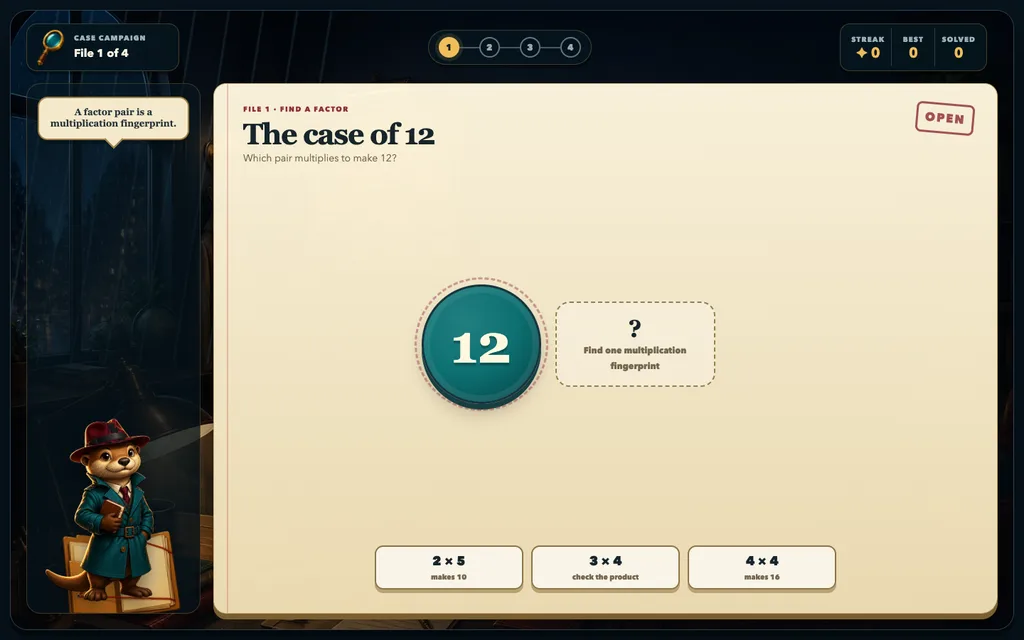
- The case of 12
Predict and test a multiplication pair, then observe that an exact product exposes factors of 12.
- The lonely 13
Test possible divisors through √13 and explain why only 1 and 13 makes the number prime.
- 18's full dossier
Build all three factor pairs for 18 and stop when the pairs would repeat.
- The odd-number alibi
Disprove the idea that every odd number is prime by finding the structure of 21.
- The square-root trap
Include the square-root boundary when testing the perfect square 49.
- The citywide sieve
Transfer factor reasoning to a 2–30 sieve, remove multiples, and identify 29 from the survivors.
- The missing multiple
Find a less-familiar factor pair for 77 and see that composites need not match easy divisibility endings.
- The crowded dossier
Build all five factor pairs of 36, including the repeated square pair, without duplicates.
- The long stakeout
Test only prime divisors through √97 and stop once the search is complete.
- The repeated fingerprint
Recognize 121 as a perfect square whose decisive factor appears at the boundary.
- The two-prime conspiracy
Expose 143 as a semiprime even though familiar small divisors fail.
- The final deduction
Transfer the shortest complete prime test independently to 157.
Ready when they are.
Play Prime Detective free — no account, no card.
Play Prime Detective free