Stat Squad
Mean, median, mode, and range describe different features of the same data: equal share, ordered middle, most frequent value, and total spread.
What your child will figure out
- Find the mode by grouping equal values and identifying the tallest frequency stack.
- Order data to find the median and use the two middle values when the set has even size.
- Find range as maximum minus minimum and mean as the total shared equally across all values.
- Choose and calculate the useful statistic in generated data sets whose size and complexity adapt to performance.
The levels
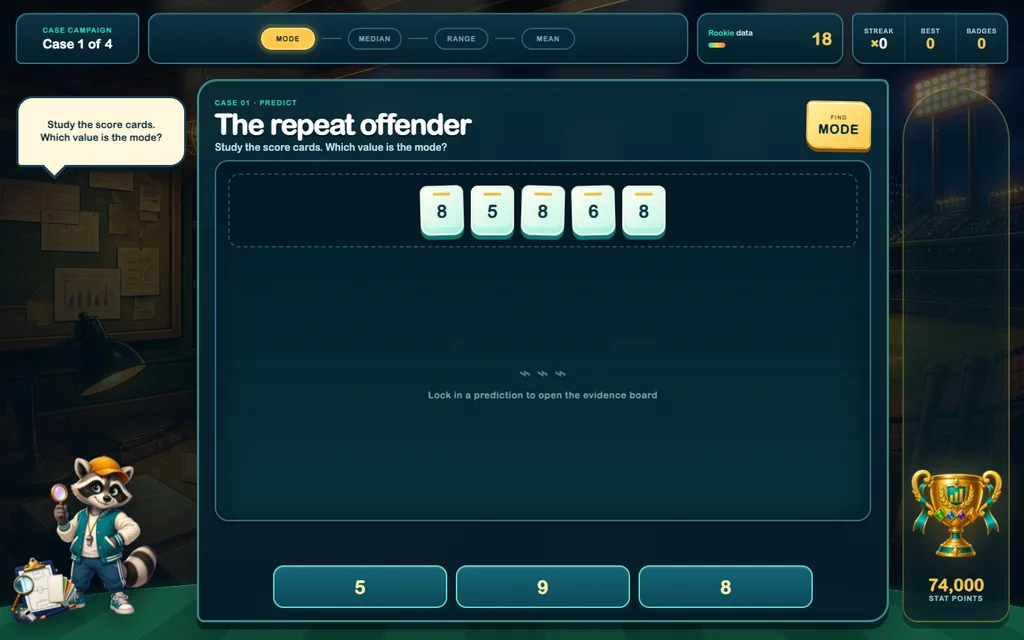
- The repeat offender
Predict the mode, stack matching score cards, observe the tallest stack, and explain why frequency—not size—decides it.
- Middle of the lineup
Predict, then order the cards and identify the middle score as the median.
- The full spread
Predict the range, stretch the number line between its endpoints, and explain maximum minus minimum.
- The fair share
Balance a five-player total into equal shares and connect the visual balance to the mean.
- The giant decoy
Reject a large but rare value and identify a smaller value as the mode from frequency evidence.
- Two at the centre
Order an even-sized set and average its two middle values to find the median.
- Double endpoints
Recognize that repeated minimum and maximum values do not change the range calculation.
- Six-way balance
Find the mean of a larger set by redistributing paired scores into six equal shares.
- The crowded stacks
Compare two repeating values and identify the uniquely tallest frequency stack.
- Duplicate defenders
Order repeated values without losing cards and locate the median position in a seven-value set.
- The runaway score
Include a distant outlier when measuring the full minimum-to-maximum range.
- Redistribution match
Find a mean when the values are uneven and no equal share is visually obvious at first.
- Championship frequencies
Resolve a dense multi-frequency set by counting every occurrence accurately.
- Half-point middle
Find a decimal median by averaging two consecutive centre scores in an eight-card lineup.
- Zero to the whistle
Use zero as a valid minimum and repeated maxima as the other range endpoint.
- The final box score
Transfer all four statistic clues to a final mean case and justify the equal-share result.
Ready when they are.
Play Stat Squad free — no account, no card.
Play Stat Squad free